
Game of Drones: The New World Disorder
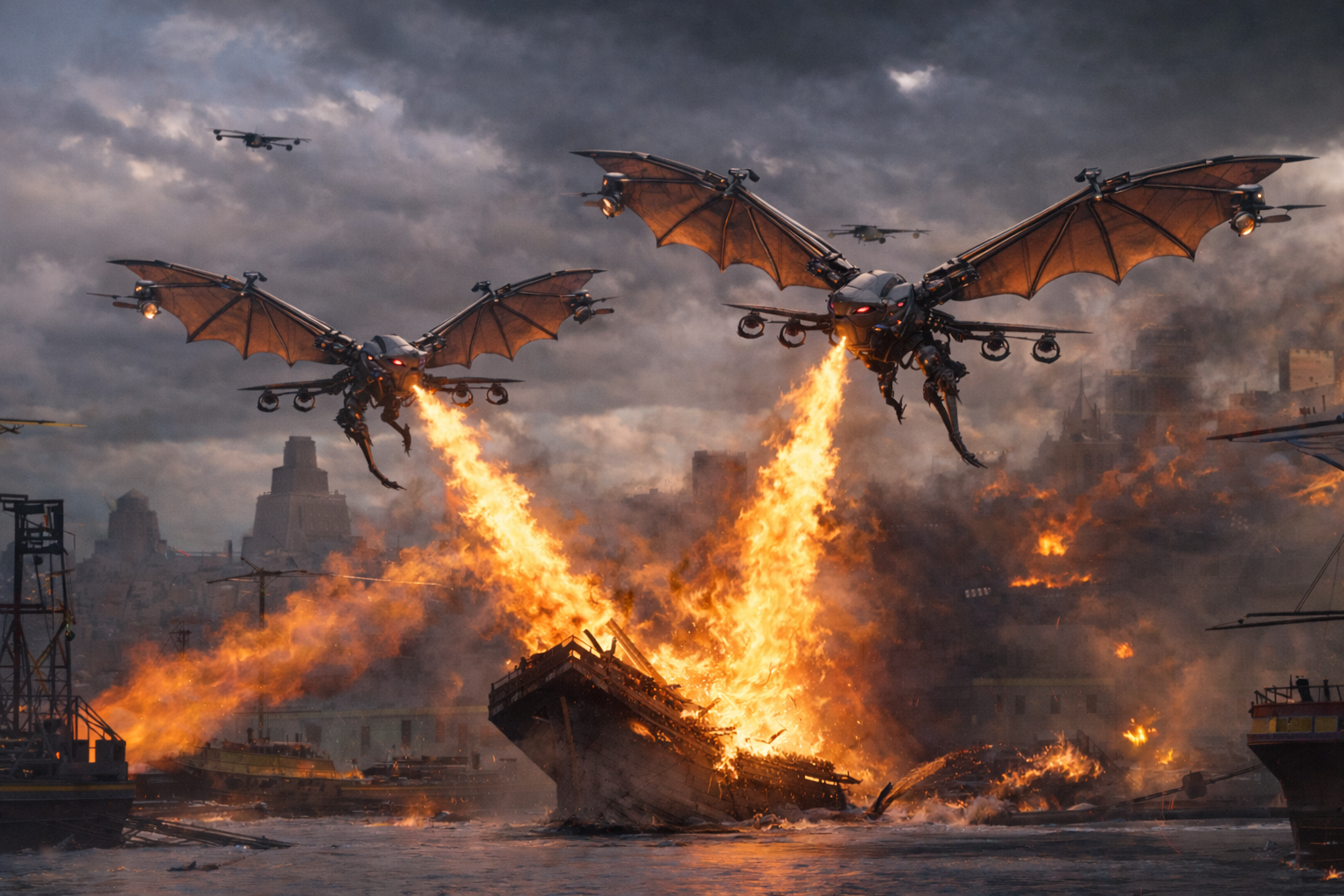
The U.S. war with Iran may be the last gasp of an old world order fighting with weapons that no longer decide outcomes. Societies evolve like species, only faster, and military breakthroughs disrupt and force them to reorganize.
The mastery of the horse expanded the reach of human violence, adding speed and shock that forced villages into larger political units. Gunpowder and ocean navigation followed, giving small European states global reach. Coal and oil concentrated power, aircraft added a new dimension, and nuclear weapons marked a quantum leap that still shapes today’s conflicts.
The U.S. and Israel attacked Iran with industrial-scale firepower. Thousands of targets were struck—missile bases, air defenses, command centers, and elements of Iran’s nuclear infrastructure. Economic damage is significant, and military losses are real, but the core objectives—regime collapse and destruction of Iran’s nuclear program—remain unrealized.
Iran is fighting a different kind of war. It has launched waves of cheap drones, missiles, and fast boats. These have damaged U.S. positions across the region and pushed naval forces into standoff positions. They have not won, but they have imposed a war of attrition with disproportionate costs on the U.S. side.
The real laboratory for modern warfare is Ukraine. What began as a conventional invasion has become something else. Ukraine survived not because it matched Russia’s scale, but because it changed the nature of the fight. It shifted from platform warfare to systems warfare. Drones turned the battlefield upside-down. A country with no navy has degraded a major fleet. A country with limited long-range strike has hit strategic infrastructure deep inside Russia.
Success depends on mass, resilience, and constant innovation. It requires millions of weapons systems, not thousands. The advantage goes to the side that learns and iterates fastest. Ukrainian drone makers update software weekly and redesign hardware every few weeks. Their military adapts tactics just as quickly. That is the new model.
The U.S. used drones in the Iran war, but mostly as part of a high-end, networked system—surveillance, targeting, and support for pilots. Iran used them differently: cheap, expendable, and numerous. U.S. capabilities were superior in every conventional sense—air dominance, precision strike, intelligence—but superiority did not translate into control.
Drones did not erase U.S. dominance, but they changed the economics of the battlefield. Bases, ports, shipping lanes, and energy infrastructure became vulnerable. Defense became expensive and incomplete.
It would be unfair to say the U.S. did not anticipate drones. It did. But their strategic impact appears to have been underestimated. That is likely because the expectation was a short war. Iran was supposed to collapse under overwhelming force. It did not.
As the war dragged on, the new weapons became more important. The turning point was not a battlefield victory but Iran’s ability to assert control over the Strait of Hormuz. It didn’t need to close it. It only needed to make passage uncertain. Insurance withdrew, ships hesitated, flows dropped. That was enough. Control shifted from naval dominance to risk tolerance. Iran turned a geographic chokepoint into an economic weapon.
That leads us to strategy.
“Before entering into a war you really need to understand the nature of the war. And I’ve got a strong sense that the Americans don’t understand the nature of the war.”
Steve Jermy, retired Royal Navy Commodore
The U.S. has objectives: destroy missiles, cripple the navy, end the nuclear program, contain proxies, keep oil flowing. That is policy—the “what.”
What is missing is strategy—the “how.”
Seven weeks into the war, there is a partial ceasefire but no clear end state. Iran is damaged, but its nuclear program, missile forces, and drone capability remain. Oil flows are still constrained. That is not strategic success.
Iran’s approach is different. It is not trying to win in the conventional sense. It is trying to make winning impossible for its adversary at an acceptable cost. It uses low-cost systems to impose high-cost responses. It attacks the backfield—bases, ships, infrastructure—and expands the conflict into the economic domain. It raises oil prices, stretches defenses, and prolongs the fight.
The U.S. defines objectives. Iran defines a method.
While the U.S. focused on Iran itself, Iran targeted the system around it—regional infrastructure, shipping, and energy flows. The move on Hormuz was decisive. Not a military victory, but a strategic one.
Trump now appears to understand that a deal is necessary. Escalation risks are higher, and munitions constraints are real. The most likely outcome is a narrow agreement—partial restoration of oil flows, limited constraints on enrichment, and no resolution of the underlying conflict.
That will be presented as success. It is not. It is stabilization on worse terms.
Helen Thompson has described the unraveling of the postwar global order as a function of energy, economics, and political stress. That system was always unstable, held together by power and financial integration.
The progression from order to disorder was inevitable because of increased complexity as population increased, the economy became globalized, energy and materials became less abundant and more expensive, and income inequality became increasingly acute.
Drone warfare has introduced something new: scalable disruption. In the old system, disruption required major state actors. Today it’s cheap, decentralized, and widely accessible. Minor powers can impose major costs. Control is harder, stability more fragile.
The Iran war did not create this shift. It exposed and accelerated it. This is not temporary. It is a structural change. Disorder is no longer the exception.
It is the system.
Like Art's Work?

Share this Post:

Read More Posts