
Iceland’s Renewable Dreams, Fossil Realities

I just returned from ten days in Iceland, drawn by the geology and stark beauty. What I found was more than scenery—it was a case history in climate change, collapse, and fossil-fueled resurrection. A treeless island made marginally habitable by a warm climate window became the setting for a long struggle against cold, isolation, and structural poverty. Today it’s held up as a model of clean energy and resilience. But look closer, and the foundations are older, deeper, and far more uncertain.
The settlement of Iceland in the 9th century wasn’t some bold Viking conquest. It was a reaction to desperate times. Norway’s elites were consolidating power, led by Harald Fairhair, who declared himself king after the Battle of Hafrsfjord around 872. Rival chieftains were forced out. So were landless men and independent farmers. With primogeniture locking up property and too many mouths to feed, many left. Some went to the British Isles. Others sailed west, toward open water and a less certain future. Among them was Ingólfur Arnarson, who landed at what became Reykjavík. He wasn’t a raider. He was a refugee.
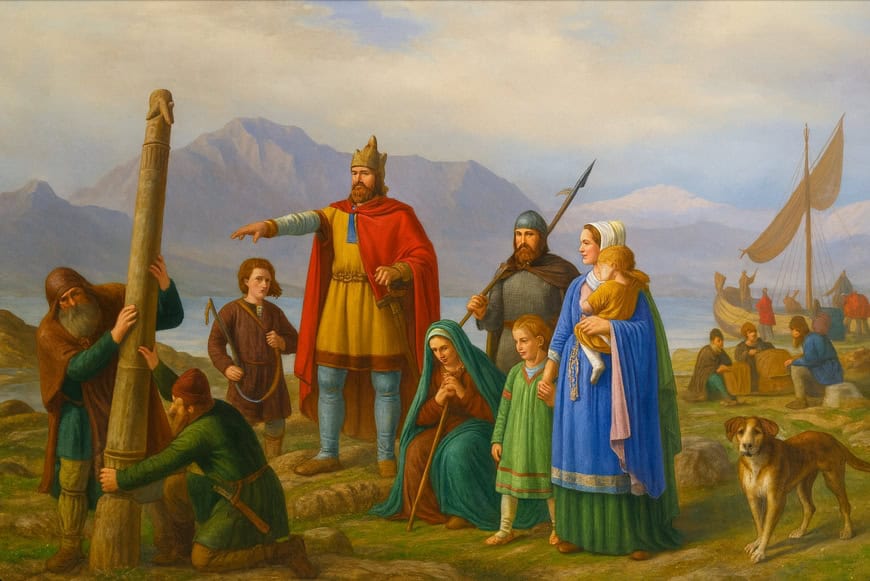
This wave of migration didn’t happen in a vacuum. It was enabled by climate change. The so-called Medieval Warm Period—roughly 800 to 1300—brought longer summers, retreating sea ice, and just enough land to farm in remote areas of the North Atlantic. A hiatus in volcanic activity, stronger AMOC circulation, and higher solar output combined to open a temporary window. Iceland, Greenland, even Vinland (likely Newfoundland) weren’t plundered—they were settled, with livestock, hayseed, and slaves. This was agricultural expansion, not conquest.
But Iceland was never easy. No grain. No metal. Almost no trees. The settlers quickly deforested what little there was, exhausted fragile soils, and locked themselves into a bleak subsistence of hay, sheep, fish, and prayer. It held together—barely—until the climate turned against them. Around 1300, the Little Ice Age began. Sea ice returned. Growing seasons shortened. Glaciers advanced. Greenland was abandoned. Iceland entered centuries of famine and disease, not to mention devastating volcanic eruptions.

The Black Death reached Iceland in the early 1400s and returned near the end of that century.
From the 14th century on, Iceland was a colony of Denmark, locked into a system of shareholder agriculture. A small class of landowners—often tied to Danish elites—controlled nearly all the land. Most Icelanders were tenant farmers or indentured laborers. The Danish Crown enforced a trade monopoly from the 1600s on, banning commerce outside licensed regions. Prices were fixed. Icelanders needed permission to own boats. The fishing industry remained small and seasonal. Life expectancy was short. Infant mortality was high. The vast majority lived in turf houses, barely surviving with limited crops and salted fish. Iceland wasn’t poor only because it was cold. It was poor because it was also controlled.
Things began to change in the 19th century. The Little Ice Age weakened. Denmark loosened its grip. Iceland was granted limited home rule in 1874, more in 1904. Cooperatives formed. Small fishing operations emerged. Reykjavík grew slowly. But the country remained overwhelmingly rural and poor. As late as the 1930s, most people had no electricity, no roads, no modern tools. It was a subsistence economy with limited exports. Iceland was one of the poorest countries in Europe by the middle of the 20th century.
Then everything changed.
During World War II, the British and then the Americans occupied Iceland. With the troops came roads, wages, hospitals, and infrastructure. Icelanders were paid to build airfields and feed the troops. For the first time, there was steady cash income, regular work, and exposure to modern goods and services. When the war ended, the Marshall Plan poured money into ports, fishing fleets, hydropower, and education. Iceland became fully independent in 1944.
Cheap fossil fuels did the rest. The fishing industry scaled up. Hydropower and geothermal capacity expanded. Roads reached into the interior. Trade networks opened. The state took an active role—investing in schools, infrastructure, and resource management. Fisheries were regulated. The economy diversified. In the 2000s, tourism boomed, sold to the world as wilderness and purity—flown in by kerosene, propped up by public investment, and sustained by global demand.
Today, Iceland has a higher per capital GDP than the U.S. and E.U. But its prosperity isn’t post-carbon. It runs on fossil-fueled trade, imported goods, and oil-powered jets and cruise ships. Nearly all its food is flown or shipped in except seafood which it exports by petroleum-powered ships and aircraft. Its aluminum smelters rely on hydro—but only because global fossil capitalism makes bauxite mining, and shipping profitable through 6-continent supply chains. The geothermal heat is local. The prosperity is not.
Iceland is a case study in strategic leverage. It took what it had—hydro, fish, hot water, scenery—and made it work. With competent governance and timely additions of outside energy and capital, it rose from subsistence poverty to modern affluence in a single generation. But this wasn’t a departure from the fossil era. It was one of its cleaner-looking artifacts.
The miracle is real, but like every fossil-fueled success, it rests on the unstable foundation of cheap, abundant oil. Iceland is fully integrated into the global superorganism—thriving when the system runs smoothly, exposed when it bends, finished when it breaks.
Like Art's Work?

Share this Post:

Read More Posts
Interestingly in the early settlement period the Icelandic Vikings supplemented their energy requirements by taking slaves, mainly from Britain and Ireland. This was so pervasive that now the majority of female mitochondrial DNA is traced back to the British Isles.
One of the most fascinating geological places I have had the pleasure of visiting.
J,
In fact, the man that Iceland’s founder Þorsteinn Ingólfsson first sent ashore was an Irish slave.
All the best,
Art
I think Icelanders know better than most how fragile their prosperity is, living in such an insecure geological and climactic location. Their ability to ride the various waves of globalisation- in industry, finance and tourism- shows just how adaptable humans can be in our desire to feather our own nests.
I recently watched a film about the strenuous efforts made by the Icelandic Forest Service to increase tree cover in the face of erosion and lava. A very worthwhile activity but, as you say, ultimately funded through participation in the global merry go round.
One day they may be forced to live more frugal lives, subsisting on mutton and fish in smaller settlements. But for now, like the rest of us, they will continue the fossil-fuelled party.
Those are good observations, Steve. Tree cover was never great in Iceland even before the Vikings cleared the trees for firewood. The place is near the Arctic Circle and only about 6% of the land is arable.
All the best,
Art
Good reminder that fossil fuels power the 21st century economy, and they are running out. Outliers like Iceland, marginal land at best, are wholly dependent on resources shipped in from the outside. In Northern Canada, diesel is flown in by airplane to remote villages. These villages cling to the coast, with an occasional inland town located near a mine.
The good/bad news is that 3rd world economic growth is stalled due to political instability and increasing oppression. How all of this will play out is anyone’s guess, but for the moment energy is plentiful and cheap. Good for us, not so good for anyone trapped in the wrong place.
Thanks for your comments, Richard.
All the best,
Art
Thank you Art! This article was very interesting and shows an example of how hydrocarbons have advanced prosperity and the quality of life! I am thinking how important natural gas is going to be with all the information, data, AI and crypto we’re growing into, The energy demand looks like it will grow abundantly!
Mark,
Iceland is a spectacular–and grim–example of what life is like and how it improves with fossil fuels. Life there was nearly impossible before the second half of the 20th century–and their doom and gloom literature and art reflects that reality.
All the best,
Art
Iceland is often cited as supposed “growth decoupled from oil” but that data without the global context is deceiving. Also it ignored the fact that Iceland has a miniscule population.
Chris,
Decoupling is an imaginary concept that only works when total energy consumption is ignored. Just because energy is used somewhere else for the products a country buys doesn’t mean it’s not used.
All the best,
Art
This reminds me of the island of St Martin’s, my parents lived there for several years. Beautiful scenery, economy 100% fueled by tourism, absolutely no ressources, not a single water stream, no trees, no other ressources. All is dependent on a diesel power plant and diesel backed ships that bring food in. Yet you find luxury hotels and 20M+ mansions everywhere you look. Evidently all this will end the day fossil fuels supply will start to decrease.
Thanks Art for all you fantastic writings! All the best.
I appreciate your comments, Alexandre.
All the best,
Art