
Peak Loneliness

As the liberal world order unravels, most are busy grieving its loss rather than trying to understand what’s really going on. Blame is everywhere—at leaders, at policies, at the right, and at the left. Everyone wants a fix, but few are asking deeper questions.
When did we decide that our happiness depends on government policies?
We’re missing the deeper issue. The biggest problem we face isn’t political or economic—it’s loneliness. In traditional societies, people were held by family, community, marriage, and religion—structures that left little room for isolation. In the modern West, those bonds have frayed. The old protections are gone, and loneliness has reached epidemic levels.
At its core, loneliness comes from disconnection—from ourselves and from the living energy of the world around us. That’s why we’re so addicted to noise, screens, shopping, distraction. We’re trying to fill a void we don’t understand.
Robert A. Johnson said the worst hell isn’t fire—it’s ice. It’s the frozen, lifeless state of being cut off from meaning and from others.
“Hell is the frozen place of unrelatedness, disconnectedness. Hell ice is worse than hellfire.“
Johnson describes three kinds of loneliness: for the past, for what has not yet come, and the deep loneliness of being near to something sacred. That last one—paradoxically—is the cure.
Backward-looking loneliness longs for the comfort of the past—the Garden of Eden, the mother’s womb, make America great again. It’s often a mask for anxiety but there’s no going back. The real enemy isn’t out there—it’s inside. Success means stepping out of comfort, into the unknown, and becoming fully responsible for your own life. That’s what makes it so frightening. Grief is a form of loneliness that looks backward.
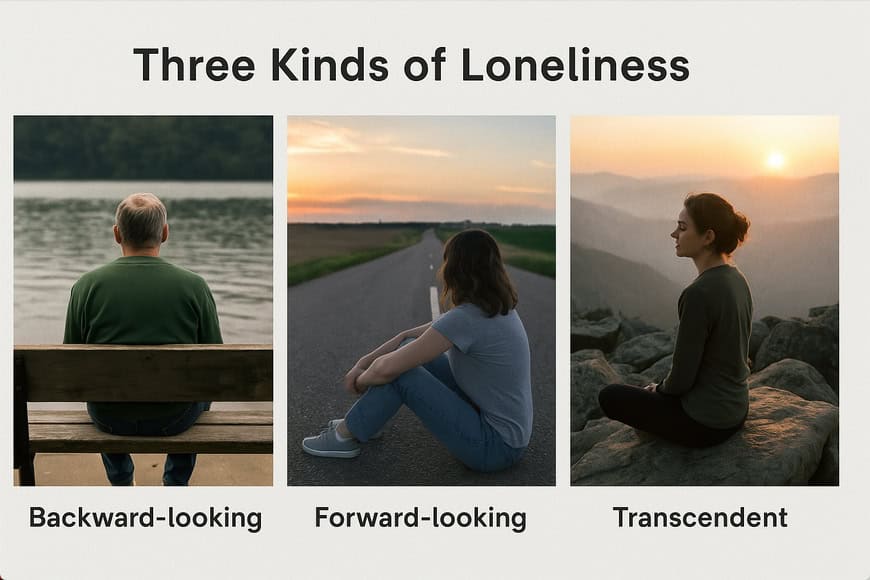
Forward-looking loneliness is longing for what hasn’t yet happened—a future imagined to relieve our emptiness. But when meaning is always placed outside ourselves, we create a trap we can’t escape. Most people live in a “just as soon as” mindset. Just as soon as I get married, get divorced, finish treatment, have more money, get rid of this terrible president, fix climate change—then life will begin.
Transcendent loneliness is the third kind—the ache of being near something sacred but unable to hold it. You glimpse beauty, meaning, or purpose, but can’t yet live it. It’s falling in love but knowing you’ll lose them, or surviving a crisis and sensing a deeper truth that soon slips away. You feel called to a more authentic life, but the gap between that vision and your reality leaves you aching.
How did we get here?
Joseph Campbell believed the Western psyche began to crack in the 12th century. Life had once moved in step with myth, ritual, and divine order. But as Christ failed to return and old symbols lost their power, a deep restlessness set in. The Black Death finished the job—shattering faith, order, and trust in the sacred story.
Then things loosened. Scholasticism rose. Authority splintered. The old symbolic world fractured. Myth gave way to science, and reverence gave way to measurement. Nature became an object, not a mystery. We stopped living within it and started trying to rise above it.
That shift birthed a new kind of impulse: the urge to master life, not endure it. To fix the discomfort of being human without needing myth. Technology didn’t just solve problems—it filled a spiritual void. Control became a form of relief.
Modern invention is often a substitute for meaning. It replaces mystery with management, vulnerability with optimization. The sacred didn’t vanish—it just got buried in circuits and code. We still reach for something beyond ourselves. The question is no longer just what we build next, but what we’re trying to escape.
Our latest technological hope is that somehow artificial intelligence will fix what we’ve broken—our planetary boundaries, our fractured institutions, our lonely and overstimulated lives. We project immense power onto AI because we’ve come to believe that only something beyond us—colder, faster, more objective—can save us from ourselves.
But this is the same old move in a new disguise. As myth faded, and we stopped living inside a shared sacred story, we began looking outward for replacements. First to conquest, then to industry, then to science, and now to machines. Each step promised relief from the vulnerability of being human—suffering, uncertainty, limits. Each step made us more powerful and, paradoxically, more disconnected.
AI is just the latest mask for the longing we no longer know how to name. It’s not really intelligence we want—it’s wisdom. It’s not calculation we need—it’s connection. We want something to make sense of the chaos, to carry the weight we’ve refused to feel, to repair the severed relationship with the living world we used to belong to.
But no machine can restore that. The ache we carry is spiritual. The loneliness we feel is mythic. We don’t need a smarter tool—we need a truer story.
We tend to blame ourselves for everything—as if our technological power made us gods. We see ourselves as the only force capable of saving or ruining the planet. In doing so, we’ve lost touch with Nature—and with the deeper nature of things.
Annie Dillard, wandering the woods and creeks of Virginia in the 1970s, saw something many miss: nature is not balanced, neat, or restrained. It’s chaotic, excessive, and endlessly generative.
“The creator goes off on one wild, specific tangent after another, or millions at once, and has never stopped.”
Nature isn’t elegant or efficient—it’s extravagant, wasteful. Not good or bad, just what is.
Alex Wendt might say that Annie Dillard is seeing the world in a way that aligns with a quantum, rather than classical, worldview.
Wendt suggests that social reality—like physical reality—is fundamentally quantum in nature. He sees human societies not as collections of isolated individuals, but as entangled systems—like particles in a quantum field. That means even small shifts in perception, behavior, or culture can ripple through the whole system in unexpected and transformative ways. Change doesn’t have to be linear or massive to matter. A small insight, a new story, a felt connection can cascade.
That’s why trying to fix climate and collapse with facts alone doesn’t work. People aren’t moved by data—they’re moved by belonging. If someone doesn’t feel rooted in something meaningful, asking them to cut back or accept limits won’t work. What we need is community. Most people in the global north don’t have places to go and talk about how they feel and what hurts. So they look for that sacred space online, in ideologies or identity tribes that function like religions. Maybe what’s needed isn’t more information but more connection.
What we’re facing isn’t just ecological breakdown. It’s a crisis of meaning, of relatedness, of loneliness. Nature doesn’t offer answers—but it reminds us that we’re not in charge, but part of something vast, wild, and alive. The real limits aren’t just physical—they’re relational. The loneliness we feel isn’t failure—it’s a signal. The loneliness of this moment is also the doorway.
The way forward isn’t domination, despair or escape. What’s needed isn’t more control or cleverness, but deeper presence and relationship—with ourselves, with each other, with the Earth. Not to fix the world like a machine, but to live in it more naturally. The way out is in.
Like Art's Work?

Share this Post:

Read More Posts
When western civilization stopped worshiping God it seems to me that the cultural elites started and over time most people followed their example and did their best to embody the qualities of Lucifer. Prideful arrogance may be our most defining characteristic.
And it seems to me that things are working out about as well as it did for Dr. Faustus.
Dobbs,
I don’t find value in populating history with saints and devils but there are discernible patterns that can help us to understand how certain trends emerged.
Joseph Campbell described a transformation from mythic identification–ego absorbed and lost in God, and its opposite, mythic inflation–the god absorbed and lost in ego. The rise of astronomical mathematics brought the cosmos and the cycles of agriculture within human reach and understanding. This, in turn, allowed leaders to feel like gods. Agricultural surpluses and the rise of war technology enabled wealth accumulation that gave leaders the power of gods.
All the best,
Art
I always enjoy your writing Art because I’m never quite sure what I’m in for. One day I’m learning about fracking or comparative inventories and the next I’m reading philosophy or psychology. Either way, it’s always good.
Thank you,
Bill
Thanks, Bill.
I’m never quite sure what I’m going to write about either until I think about what affected me during the last week.
All the best,
Art
Great piece thanks Art.
These are the best words I’ve read in a long time… “The loneliness we feel isn’t failure—it’s a signal”
Thanks Grant.
I’d add that the same is true for depression.
All the best,
Art
I recently wrote this up on loneliness. Most would consider me to be lonely, but I’ve largely abandoned modernity and I’m at peace with both myself and the world out there I no longer care about…
https://damnthematrix.wordpress.com/2025/04/27/on-loneliness-and-awakening/
Michael,
Alan Watts was probably my first exposure to Zen sometime in my late teens or early twenties.
All the best,
Art
Ecclesiastes 1:2 “Vanity of vanities… all is vanity.” Ancient King Solomon wrote all about life’s meaning in this book of the Bible. I recommend reading what he says about life. It makes sense.
Thanks, Mark.
Recognizing that there are limits is important. Much of what we believe about permanence and control is an illusion supported by our egocentric and false cultural story.
All the best,
Art
Just in case you don’t have time to read the entire book, here’s Solomon’s conclusion (Ecclesiastes 12:13-14):
Now all has been heard;
here is the conclusion of the matter:
Fear God and keep his commandments,
for this is the duty of all mankind.
For God will bring every deed into judgment,
including every hidden thing,
whether it is good or evil.
And, one minor correction to the article, Christ didn’t “fail to return” … He’s not due back until 2033 ;).
Roger,
I’d caution those who interpret such documents to do it in the metaphorical way they were written. Part of the reductionist curse of modernity is literalism.
I would interpret Solomon’s advice to mean that we should live with reverence to the divine center of the human psyche, and align our lives with that truth. Judgment isn’t about external punishment, but our own failure to strive toward wholeness and integration of our psychological conflicts.
As Jung said,
Our deepest duty is to live consciously and truthfully, honoring the sacred pattern within.
All the best,
Art
Dear Art,
I have followed your work for some time now.
Your discussions with Nate Hagens were great but I think you have transcended.
Your recent works are simply beautiful showing a depth of understanding and empathy that I do not see anywhere else.
I was deeply moved by Maximum Power Minimum Awareness and now this piece.
Thank you for shinning the light.
Larry
Larry,
I really value your comments.
All the best,
Art
95% is top-notch! I’ve already saved this powerful story in my database. I just have one small comment on the remaining 5%: leave the quantum bullshit alone. I’m sorry to be so blunt, but I have a PhD in Theoretical Physics and I don’t like to see quantum physics being used to explain everything. Couldn’t resist saying so, but again, the rest is fantastic, thank you.
Christophe,
I appreciate your comments about quantum applications to macro level social phenomena. I’d suggest that perhaps your closeness with the subject introduces some paradigm bias.
I recommend that you read Wendt’s work Quantum Mind and Social Science: Unifying Physical and Social Ontology along with Henry P. Stapp_2006_Quantum approaches to consciousness_Lawrence Berkeley National Laboratory, Danah Zohar_2022_Zero Distance Management in the Quantum Age, Calzati & de Kerckhove_2024_Quantum Ecology Why and How New Information Technologies Will Reshape Societies, and Andreas Weber_2014_Matter and Desire- An Erotic Ecology by Andreas Weber.
All the best,
Art
a paradigm bias or may be a clear understand of what QM is and what it is not;-) I know both Henry P. Stapp and Danah Zohar, your other references not. hmmm, I think they’re missing the point of consciousness.
But, I stop this sidetrack, it is also not really the point of your article.
you say “He sees human societies not as collections of isolated individuals, but as entangled systems—like particles in a quantum field.”. I agree on what you mean, but in my view QM is just used here as a vague analogy void of the properties of entangled particles! Humans ARE strongly influenced by the social network in which they live, to the point of being a victim of “network bias”. But nothing alike the “spooky action at a distance” of entangled particles, which would feel like a strange telepathic sense.
I don’t think the analogy serves your otherwise good argumentation.
btw. it is always a joy to receive your newsletter!
Thank you, Christophe.
My perspective is that quantum theory, in its technical form, applies to subatomic systems. But that doesn’t mean its principles—such as indeterminacy, entanglement, and observer effect—have no relevance beyond physics. It undermines the mechanical worldview that most thoughtful humans embrace. It invites a shift toward models that reflect the complexity, interdependence, and uncertainty of human systems—qualities we ignore at our peril.
All the best,
Art
I’ve been trying to follow this path for two decades. But it’s a tough sell.
It seems to break down into petty arguments about unimportant details. It seems to come to personalities over community. It seems to suffer from high expectations and subsequent disappointment.
What does “community” mean to you?
I know, that at least a whole ‘nother article, if not a book…
Jan,
Community begins with people talking about how they feel. Barton numbers suggest that a community can’t be more than about 300 people. Beyond that, all I can say is that we’re nowhere close to either right now.
Best,
Art
The loneliness of living in the forced labor camp we call industrial civilization. No time to connect with family, friends, civic engagement, or nature after either working 10 hours+ at your white collar professional job or after working 2 or more blue collar jobs. No time for children to run wild and free between school, after school sports and music lessons, daycare, and homework. The loneliness is fueled by our fossil-fueled high-energy no-down-time lifestyles.
Robin,
Loneliness began long before industrial civilization began. I’m reading The Odyssey and it was a big problem 3000 years ago.
All the best,
Art
…Technology for filling a spiritual void… Now, that’s really scary.
Alex Wendt comes us with a useful metaphor but it is somewhat farfetched to literally see quantum entanglement in macroscopic social relationships.
I am of the opinion that humans, with their curse of being blessed with too much consciousness, constitute a real tragic species. We don’t know how to deal with this curse. I’m afraid that the majority will continue to look for meaning in places or structures that are the antithetical to this quest. I really hope that there is a way to voluntary renounce the unsustainable energy guzzling civilization that brought all this stuff and gadgets. Unbridled consumption and looking forward to the next great gadget seemed like a good stand-in for the loss of meaningful relationships with real fellow humans. That illusion is now in the process of being shattered. What comes next in the search for meaning? I don’t know.
Ray,
Wendt’s ideas are controversial and he is the first to acknowledge that and why. Still, it is this kind of thinking that helps expand our Overton window.
I suggest that you read this paper “Type Indeterminacy: A Model of the KT(Kahneman–Tversky)-Man”
https://arxiv.org/pdf/physics/0604166
All the best,
Art
That was very well written and very true
Thanks, AA.
Best,
Art
I’m enjoying your philosophical posts, Art. Interesting that Robert Johnson says that, “the worst hell isn’t fire—it’s ice.” Dante would agree with him. His Ninth Circle of Hell has Satan and the worst sinners locked in eternal ice. specifically the frozen lake Cocytus, formed by Satan’s tears and the cold wind created by his flapping wings as he tries to escape. I think you’re on to something when you say that loneliness and disconnection are related. Of course, there’s social disconnect, the lack of human unity. But far more damning, in my mind at least, is our disconnection from nature, an existential crisis. Without that connection, we are acontextual, and without context life is meaningless.
Frank,
Those are fascinating observations about The Inferno. I 100% agree that it is our disconnection from Nature and our own psychic natures that is at the root of the loneliness and meaning crisis.
All the best,
Art
There are a lot of ways to explain what is happening as other than the natural disintegration of popular culture and this article is one of them. These ideas of loneliness are in fact part of the cement that structures of this natural disenfranchisement
I appreciate your comments, John.
All the best,
Art
Very nice ode to the loanly!
Thanks, Tom.
All the best,
Art