
Populism: The Fourth Horseman of The Coming Decade

Populism is on the rise around the world.
It disrupts established political systems, creates uncertainty, and deepens societal divisions. This fundamental crisis of governance and the social contract is Nate Hagens’ fourth horseman of the coming decade (Figure 1).
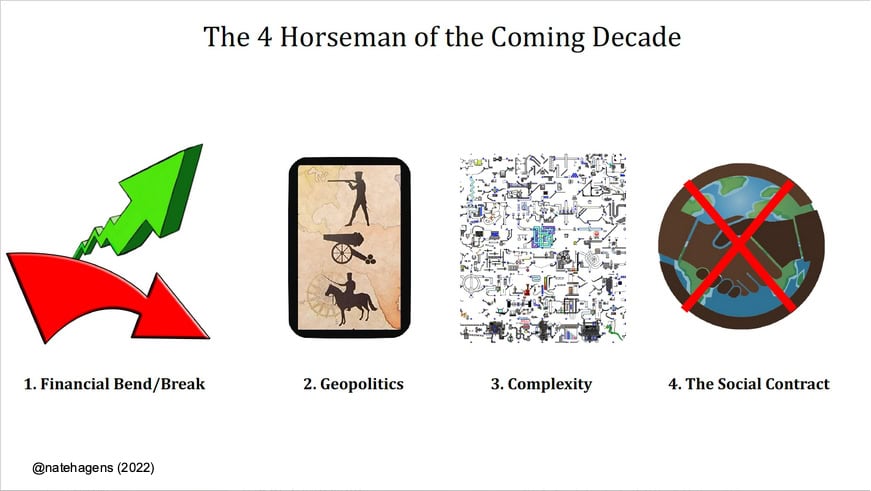
Source: Nate Hagens.
Climate change and the ecological crisis undoubtedly pose greater long-term threats to the planet compared to the four horsemen. However, in the immediate future, these environmental challenges are less likely to threaten human systems.
Although populism’s resurgence can be explained by worsening economic conditions for average people, its basis in psychology is equally compelling. This suggests that the horse is at least as important as the horsemen for understanding today’s human predicament.
Steve Bannon’s Unsettling Interview
The social contract is the implicit agreement between individuals and government. People collectively agree to surrender some of their freedoms in exchange for protection of their remaining rights and the maintenance of social order.
Weak or failed government can lead to protests, and even violent uprisings if people lose faith in the system, and take matters into their own hands. Outcomes include financial turmoil, unemployment, inflation, and poverty. In extreme cases, failed governance may lead to mass migration, refugee crises, and environmental degradation.
“We see polarization and the dissipation of trust all around the world. There’s a rightward shift in politics because people are afraid of things they don’t know, and of…austerity.
“We have to have the ability to have a discourse. My friend Dick Gephardt often says that politics is a substitute for violence. The social contract is keeping people talking to each other about the issues that matter.”
Nate Hagens
The populist shift in Europe has been characterized by the electoral gains of parties such as Marine Le Pen’s National Rally in France, Matteo Salvini’s League in Italy, and the Alternative for Germany (AfD) party. These often advocate for nationalist and anti-immigration policies, as well as Euroscepticism.
David Brooks’ recent opinion column, “My Unsettling Interview With Steve Bannon,” offers valuable insight into the essence of populism. Bannon is a political strategist, media executive, and former investment banker who played a significant role in Donald Trump’s rise to the presidency.
He envisions a global populist movement capable of taking over the world. Bannon believes the ruling elites of the West have lost the confidence of their people, and he aims to empower the populist movement to replace them. In his view, immigration is the driving force behind the populist surge, as it contributes to declining jobs and opportunities for working people.
“The ruling elites of the West…are more and more detached from the lived experience of their people…So you’re going to go to war with the existing administrative state and the Praetorian Guard deep state.
“Americans have to get a better deal. Right now, the American citizen has all the obligations of serving in the military, of paying taxes, of going through this grind that is American late-stage technofeudal capitalism. But tell me what the bonus is?
“The historical left is in full meltdown…They don’t understand the MAGA movement. They will look back fondly at Donald Trump. They’ll ask: Where’s Trump when we need him?”
Steve Bannon
And then what, Steve?
After the French Revolution in 1789, a decade of chaos ensued. The elites were replaced by the eighteenth-century equivalent of Bannon’s populists. The economic consequences were severe and widespread, causing significant hardship for the French people. Production and trade declined, agricultural output fell, and the nation faced hyperinflation, food shortages, corruption, and the seizure of private property.
Similarly, the Russian Revolution and Civil War (1917-1922) caused massive economic disruptions. Infrastructure was damaged, industrial output plummeted, and there were widespread shortages of goods and services. The average Russian faced significant hardships, including food shortages, unemployment, and a sharp decline in living standards.
In most modern revolutions, elites are simply replaced by new elites, and it’s not uncommon for the old elites to regain power within a few decades.
Much of the current discontent stems from frustration with those in power. Voters and citizens worldwide demand the impossible from their governments, using politicians as convenient scapegoats for collective woes. Populists, often untested in office, are quick to make grand promises.
The Crash Test in France
It would be one thing if Steve Bannon, Donald Trump and the MAGA Republicans were uniquely American phenomena but, of course, they’re not. In France, after the second round of voting for the National Assembly, Macron’s Renaissance (RE) government has collapsed. The Prime Minister has resigned, and the political landscape is dominated by Le Pen “of the far-right National Rally (RN) and Mélenchon of the far-left France Unbowed (La France Insoumise, LFI). This leaves France without a clear governing majority.
The center RE and left LFI parties came together in the runoff election in order to block Le Pen’s RN party from taking power but are otherwise divided. This situation reflects the fractured nature of France. Many believe that a far-right takeover is inevitable sooner rather than later.
“It is the crash-test of the system à la française, which is no longer fit to deal with today’s political forces.”
Tristan Mendès France
The political landscape has shifted dramatically. What was once a stable, two-party system dominated by a single majority has splintered into fragmented factions. This has intensified the political discourse, pushing it towards the extremes.
“More than three out of every five French voters in the first round supported parties whose views were once considered extreme. Labeled far-right or far-left, many of them are united in their animosity toward the so-called center and what they perceive to be its elitist governing style.”
Antonia Colibasanu
French philosopher Alain Finkelkraut has recently warned of the “Lebanonisation” of France—a society splintering into warring factions with no shared interests. He paints a picture of a nation fracturing, each group entrenched in its own grievances and ideologies, eroding any sense of collective identity.
Many consider France ungovernable—Hagens’ fourth horseman.
Complexity scientist Peter Turchin argues that one of the critical factors of societal instability is what he calls elite overproduction. Intraelite competition, and economic inequality can lead to social disintegration. Turchin’s model seems overly simplistic but it provides a useful framework for understanding simplistic populist thinking. Get rid of the elites. Replace them with leaders who understand “the lived experience of their people,” and a much better world will result.
The Rational Narrative
A more straightforward explanation for populism is the worsening economic situation for average people. The 2023 report on the Economic Well-Being of U.S. Households revealed that 37 percent of Americans cannot cover a $400 emergency expense without borrowing money or selling something—roughly the same percentage of voters who support Donald Trump.
The same report found that inflation was the biggest economic concern, affecting over one-third of respondents (Figure 2). This was followed closely by worries about basic living expenses and housing. These responses underscore the ongoing struggles many face in maintaining financial stability amid rising costs and economic uncertainty.

Source: U.S. Federal Reserve Board
Ray Dalio suggests that today’s surge in populism is related to the culmination of a long-term debt cycle (Figure 3).
Over time, economies and financial systems accumulate debt. To encourage borrowing and spending, central banks lower interest rates, which can lead to even more debt and higher asset prices. Eventually, debt levels become unsustainable. Borrowers struggle to service their debts, reducing spending and investment, and slowing economic growth. This unsustainable debt often peaks in a financial crisis, as seen in the Great Depression and the 2008-2009 financial crisis.

Long-term debt cycles can aggravate income inequality. Wealthier people and corporations generally have better access to credit and can borrow at lower interest rates. They leverage this to invest in appreciating assets, further increasing their wealth. In contrast, those with lower incomes often face higher borrowing costs and may use credit for consumption rather than investment, resulting in a cycle of debt without wealth accumulation.
“Gaps in wealth and values led to deep social and political conflicts in the 1930s that are similar to those that exist now…It also showed me how and why populists of the left and populists of the right were more nationalistic, militaristic, protectionist, and confrontational—and what such approaches led to.”
Ray Dalio
Figure 4 illustrates how the end of a debt cycle in the 1930s coincided with what Dalio calls an era of populists. As the next debt cycle began, conditions improved for the lower 90 percent of Americans into the 1980s and 1990s—a period that MAGA Republicans nostalgically reference in their call to “make America great again.”
Over the last three decades, the wealth of the lower 90 percent of Americans has deteriorated, while the upper 0.1 percent have flourished.

Source: Bridgewater Associates
Another characteristic of debt cycles is that economic growth declines when debt levels become so high that they no longer contribute to productive capacity. Figure 5 illustrates how per-capita U.S. economic growth has decreased over the last 75 years, dropping from more than 2.5 percent of GDP in 1971 to less than 1.3 percent in 2023.

Source: Hoisington Investment Management through Mauldin Economics, May 3, 2024
The True Believer
That’s the rational explanation for today’s populist upheavals, rooted in economic desperation and a longing for better times. But there’s also an irrational, psychological dimension that provides deeper insights into populism and broader aspects of the human predicament. This includes our distorted relationship with ourselves and the natural world, reflecting deeper existential and societal fractures.
In 1951, Eric Hoffer published The True Believer, a groundbreaking study on the psychology and dynamics of mass movements. Although he focused on Communism, Nazism, and Fascism, these were essentially populist phenomena, driven by the same currents of collective discontent and the quest for identity and purpose.
Hoffer suggested that people who join mass movements often seek to escape their own ineffectual lives. By becoming part of a larger cause, they find meaning and a sense of importance that their personal lives lack. The leaders of these causes are skilled at articulating the grievances and aspirations of their followers, often exhibiting charisma and the ability to inspire and mobilize the masses.
“The majority of people cannot endure the barrenness and futility of their lives unless they have some ardent dedication, or some passionate pursuit in which they can lose themselves…The chief passion of frustrated people is to belong.
“A movement attracts and holds a following because it can satisfy the need for self-renunciation; a substitute for individual hope; movement toward a promised land…it is the around-the-corner brand of hope that prompts people to act.”
“All the true believers of our time…declaim volubly about the decadence of the West…Every mass movement shapes itself after its own specific demon…Though hatred is a convenient instrument for mobilizing a community for defense, it does not, in the long run, come cheap. We pay for it by losing all or many of the values we have set out to defend.”
Eric Hoffer
Hoffer believed that true believers are fanatically engaged, and posses a sense of absolute certainty—an unwavering commitment to their cause—that often leads to extreme behavior and intolerance of dissent. Ironically, the underlying psychological need for belonging and purpose is more significant than the specific beliefs of the movement.
Hoffer’s analysis sheds light on Steve Bannon’s apparent indifference to what comes after the revolution.
“The creative man of words, no matter how bitterly he may criticize and deride the existing order, is actually attached to the present. His passion is to reform and not to destroy.
“Not so the fanatic. Chaos is his element. He glories in the sight of a world coming to an end.
“He shoves aside the frightened men of words.”
Eric Hoffer
Collective Neurosis
Several decades before Hoffer, Carl Jung revolutionized psychology by introducing the concept of the collective unconscious. Sigmund Freud had earlier described the unconscious mind as that part of our psyche where fears, insecurities, uncomfortable desires and unresolved conflicts are repressed. Freud’s psychoanalysis tried to bring these unconscious aspects of personality into conscious awareness.
Jung’s collective unconscious is a deeper layer of the psyche that is shared by all humans. It functions as the human operating system, encompassing the accumulated experiences and knowledge of our species. Jung understood Freud’s unconscious as a layer between the conscious mind and the collective unconscious which he referred to the shadow. This distinction is crucial: Jung’s shadow is personal, containing repressed memories and desires, while the collective unconscious is a genetic memory passed down through generations.
Jung believed that modern technology has increasingly disconnected large numbers of people from functional contact with the collective unconscious, causing it to atrophy. As a result, many live in a perpetual state of neurosis—a mental disorder marked by emotional distress and difficulties in managing everyday life. Neurotic symptoms include anxiety, depression, obsessive thoughts, and compulsive behaviors.
Jung suggested that much of what we modern humans dismiss as stress is, in fact, neurosis.
Archetypes that reside in the collective unconscious are central to Jung’s work. These universal, symbolic patterns or images represent fundamental human experiences and themes, such as the mother, the hero, the trickster, God, and the wise old man. Archetypes are similar across cultures and time periods and are expressed in myths, fairy tales, religious stories, and dreams.
Throughout most of human history, people projected these archetypes onto nature. By assigning symbolic meaning to mountains, rivers, trees, and animals, they experienced a sense of the sacred and the divine in the world around them. This understanding allowed them to see themselves as part of something greater. Recognizing archetypal patterns in nature fostered a sense of connectedness, unity, and harmony with the natural world, making neurosis much rarer in those times compared to today.
Jung observed that the invention of writing in Mesopotamia near the end of the fourth millennium BCE marked the beginning of a long shift away from archetypal projections onto nature. Written records contributed to a more rational and structured worldview, diminishing the fluid and dynamic nature of oral traditions. Technological advances such as metallurgy, the wheel, and mastery of the horse expanded trade networks, warfare, and the accumulation of wealth and resources. These developments fostered a more practical and empirical mindset, further distancing individuals from mythic projections and the collective unconscious.
My Kingdom for a Horse
Joseph Campbell viewed the Bronze Age (3000-1200 BCE) as a period of relatively strong psychological integration. Although life was undoubtedly difficult, dangerous, and often short, myth and religious practices fostered a deep connection with nature. This connection contributed to a general sense of satisfaction and stability despite life’s harshness.
“With the mastery of the horse, however, all things changed.
“At some point in place and time…roughly c. 2000 B.C., and probably north of the Caucasus range, the light two-wheeled chariot drawn by two swift horses came into use…And with the advantage of this mobile military arm, new empires suddenly came into being in unforeseen parts of the world.
“Furthermore, in Southeastern Europe, c. 1500 B.C., a new weapon, the sword, appeared, contrived for slashing from the saddle. From somewhere men were coming who had learned to ride…gradually welding by violence and empire the far-flung provinces of the earlier, centrifugal ages; so that the world that formerly had been divided was now gradually being brought together—but with a radical split horizontally between those who cry “Victory!” and those who weep.”
“All the way from the Nile to the Yellow River the lesson of the inevitability of sorrow was learned by those in the role of the anvil from those with the mettle to be hammers, and with that, the golden age of the children of the Earth Mother was of yore.”
Joseph Campbell, Oriental Mythology
Mastery of the horse was arguably the most disruptive development in human history.
It revolutionized transportation and warfare, enabling rapid movement and territorial expansion. This newfound mobility contributed to the breakdown of localized, mythic communities and the rise of larger, more centralized political structures. The horse facilitated conquest and empire-building, reinforcing hierarchies and the prominence of individual leaders and heroes, thus enhancing ego-centric worldviews.
While the accumulation of surplus is commonly associated with the advent of agriculture and the growth of cities, the surplus acquired from the plunder of war was greater and more immediate.
Joseph Campbell referred to this as the “great reversal,” where mythic consciousness was replaced by a more linear and individualistic worldview. Dramatic societal and cultural shifts disrupted established ways of life, bringing about a pervasive sense of uncertainty and discontent. The earlier connection with nature diminished as technology and material concerns progressively replaced the mythic framework of earlier times.
Which Hemisphere is Better?
Iain McGilchrist’s ongoing neuroscience research into brain hemisphere specialization builds upon Carl Jung’s earlier work. McGilchrist’s findings indicate that the two hemispheres of the brain, while interconnected, process information differently and have distinct but complimentary functions.
The right hemisphere is responsible for holistic thinking, context, and integrating information, enabling us to perceive the world in a connected and meaningful way. The left hemisphere focuses on analytical thinking, language, details, and sequential processes, excelling in abstraction, categorization, and systematic analysis. Table 1 summarizes some of the key functional differences between left and right hemisphere thinking and processing.

Source: Iain McGilchrist and Labyrinth Consulting Services, Inc.
The left hemisphere drives actions and tasks with a narrow focus, often missing the broader context and failing to anticipate or notice the negative effects of its actions. It jumps to conclusions quickly and then believes its own narrative. The right hemisphere serves as the left’s “bullshit detector,” providing context and real-world experience to balance the left’s preference for action. McGilchrist uses this analogy to illustrate the dynamic between the two hemispheres.
“A bird must be able to distinguish a seed from the background of gravel on which it lies, and pick it up swiftly and accurately; similarly, with a twig to build a nest (left hemisphere).
“Yet if the bird is to survive, it must also, at one and the same time, pay another kind of attention to the world…on the lookout for predators…but also, crucially, to the appearance of the utterly unfamiliar (right hemisphere).
Ian McGilchrist
In other words, the bird must make sure it doesn’t become someone’s lunch while eating its own lunch.
The left hemisphere, associated with the ego, focuses on individual identity and rational thought. In contrast, the right hemisphere, linked to the unconscious, connects to deeper, often non-verbal experiences and collective patterns of meaning.
Jung’s collective unconscious, where archetypes reside, is similar to the right hemisphere’s integrative and holistic functions. The right hemisphere’s ability to recognize patterns and symbolic meanings parallels Jung’s archetypal symbols that emerge in dreams, myths, and religious experiences.
McGilchrist argues that modern civilization has increasingly favored left-hemisphere thinking, leading to a fragmented, overly rational approach to life. The shift has come largely at the expense of community, creativity, spirituality, and a sense of connection with the natural world.
“Our intelligent capacity to make sense of the world is in decline because…the right hemisphere’s understanding is being elbowed out by the left hemisphere’s insistence that we see the world its way, even though this way is less intelligent.”
Ian McGilchrist
McGilchrist believes that the increased cultural bias towards left hemisphere thinking is leading to cognitive problems like attention deficit. Modern technology, with its constant distractions and emphasis on quick, fragmented information, compounds left-hemisphere dominance.
Attention deficit is part of a spectrum that includes schizotypal and autistic disorders. Most medical experts attribute seventy to eighty percent of attention deficit disorders to organic or genetic origins. McGilchrist acknowledges this but sees it as intertwined with psychological and societal influences. Attention deficit reflects a lack of context and an inability to distinguish what is important from what is not, essentially a lack of common sense—the domain of the right hemisphere.
When you factor in the pervasive fear driven by unchecked social media and relentless political propaganda, the rise of populist movements becomes much clearer.
“What the subject with schizophrenia, particularly, experiences is a very alarming world…For them, their experience is authentic and more compelling, than any argument…It is a take on the world that we can all approximate…if we become sufficiently dependent on the left hemisphere alone.”
“Every phenomenon described by people with schizophrenia bore close resemblance to phenomena not just found in, but at the core of, modernism.”
Ian McGilchrist
This perspective helps explain the grip of populism on intelligent, accomplished people. Arguing with those whose reality is shaped by the alarming narratives of social media pundits like Steve Bannon, using an evidence-based approach, is largely futile.
This doesn’t mean that large numbers of people are schizophrenic or psychotic. Rather, they are anxious and neurotic. Personality disorders exist on a spectrum—much like political beliefs—with considerable variation and overlapping symptoms depending on situations and issues.
When the truth-testing, modulating effect of right hemisphere processing is weakened, people are more prone to blowing things out of proportion. The rise in conspiracy theories supports this idea.
“We are part of the most ridiculous era of humanity in which completely improbable and very stupid things are said by highly intelligent people. And if they had any contact at all with their intuitions, they would guide them to a much, much wiser place.”
Ian McGilchrist
The Fragmentation of Consciousness
David Bohm, through his work in quantum physics, arrived at similar conclusions. He believed that the most serious problem for society was the fragmentation of consciousness.
“Well, I think the difficulty is this fragmentation. First of all, everybody’s thought is broken up into bits: this nation, this country, this industry, this profession and so on. And it’s extremely hard to break into that.
“People cannot see that they are creating a problem and then apparently trying to solve it. Let’s take the problem of pollution, or the ecology. The ecology is not in itself a problem, it works perfectly well by itself. [The problem] is due to us!”
David Bohm
Modern physics suggests that wholeness is the true nature of reality, while fragmentation is merely an artifact of thought. Humans have artificially divided the world into parts, making our worldview a derivative of reality. This divided thinking leads to conflict, environmental destruction, and societal problems.
“Fragmentation is now very widespread, not only throughout society, but also in each individual; and this is leading to a kind of general confusion of the mind…to such an extent that it is generally accepted that some degree of neurosis is inevitable, while many individuals going beyond the ‘normal’ limits of fragmentation are classified as paranoid, schizoid, psychotic, etc.
David Bohm
From an early age, people are taught to analyze and solve problems by breaking them down into discrete parts, rather than seeing them as interconnected wholes. While useful in many contexts, this method of thinking limits our ability to see the bigger picture.
This mindset has led to widespread pollution, ecological imbalance, overpopulation, and global economic and political chaos. As a result, it has created an environment that is detrimental to both the physical and mental well-being of most people.
“Men have been aware from time immemorial of this state of…fragmentation and have projected myths of a yet earlier ‘golden age’, before the split between man and nature, and between man and man had taken place. Indeed, man has always been seeking wholeness—- mental, physical, social, individual.”
David Bohm
The dominant scientific and philosophical paradigms of the modern era, particularly the mechanistic and reductionist worldview, emphasize separation and categorization. This perspective provides a flawed and distorted view of reality, manifesting in social and political conflict.
Bohm believed that societies have become divided into opposing groups, each viewing the other as an enemy. Political and social ideologies have become rigid and inflexible, with people clinging to their fragmented views and are unwilling to consider alternative perspectives. As a result, complex problems are oversimplified, leading to solutions that fail to address the underlying issues.
It’s a Predicament, Not a Problem
Populism arises when groups feel ignored by their government and the system, believing their interests are not represented. It’s more than just a call for regime change; it is a reactionary revolt against the status quo, a denial of reality, and a need to blame political leadership. Populism often lacks a Plan B, a “then what?” It reflects a deeper psychological predicament.
“Rapid advances in science and technology cast such a spell over man’s conscious mind that it forgot the unpredictable forces of the unconscious. Once more we see people cutting each other’s throats in support of childish theories of how to create paradise on earth.
“The change in character brought about by the uprush of collective forces is amazing. A gentle and reasonable being can be transformed into a maniac or a savage beast. One is inclined to blame it on external circumstances, but nothing could explode in us if it had not been there. We constantly live on the edge of a volcano. It only needs a neurosis to conjure up a force that cannot be dealt with by rational means.”
Carl Jung, Psychology and Religion
Problems may have solutions; predicaments arise when multiple interrelated problems compound each other. Solving one issue may only shift the problem somewhere else or make things collectively worse. Predicaments may be manageable, but they rarely have clear solutions.
Society’s predicament is the aggregate of the problems of its individuals, suggesting that changing the tide of populism might not be possible. At the same time, understanding its nature allows for different approaches to managing it. Since reason, logic, facts, and criticism are largely ineffective, we should abandon those methods. Instead, we should address the core issues: feeling ignored, disrespected, and unrepresented.
In the broader context, populism, governance, and the social contract represent just one of the four immediate threats facing humanity in the coming decade. The four horsemen do not encompass the ongoing destruction of ecosystems, loss of biodiversity, and climate change, which jeopardize the planet’s capacity to support human life.
Human behavior is the horse on which populism and other horsemen ride.
A fundamental shift in our understanding and interaction with the world is essential, emphasizing the need for systemic change, and a deeper awareness of balancing human needs with planetary limits. This shift is unlikely to happen without a world-changing catastrophe that forces behavioral change upon us.
Many accuse their opponents of being threats to democracy, forgetting that dismissing the will of half the populace spells the end of democracy.
In the meantime, let’s stop wasting time treating the human predicament as a mechanical problem solvable by replacing parts and adjusting settings. We should acknowledge that human behavior is the core issue. Addressing the root cause rather than just the symptoms would be a significant step in the right direction.
Like Art's Work?

Share this Post:

Read More Posts
Somehow I missed this article at the time of publication. Fantastic bit of philosophy. I’m glad you linked to it from The End of Climate-Change Idealism.
Connecting the hemispheres into coherent operation requires adoption of a regular practice, whether it be meditation, yoga, animist ritual, prayer, or controlled psychedelics. It requires stepping outside of the maelstrom of sensory bombardment.
In the book Sand Talk, Tyson Yunkaporta paints a picture of three different forces portrayed as animals working in concert to restrain the sociopathic archetype of emu. Had the Bronze Age society mobilized to reign in the horsemen, perhaps the cycle of conquest and tears could have been stopped. At present, the horsemen are galloping out of control.
In order for the mostly-decent general public to come to their senses and hold both the elites and the counter-elites to account, they need to be given (a) enough sovereignty over their own livelihoods and (b) some sort of psychic practice.
Several of the people interviewed by Nate Hagens, as well as others such as Transition Town leaders and all manner of practitioners, seek to establish “islands of coherence” in the midst of the maelstrom. Each such island stands a chance of attracting more coherence, like how sugar molecules acrete along a string to form crystalline rock candy.
Start small. Embrace the butterfly effect.
Robin,
I’m glad you found the post useful.
I don’t think anyone could have understood the implications that horse-mobility provided.
All the best,
Art
Art I am an amateur energy analyst and I have followed you for decades and this post was a real gem of subjects unrelated to energy. You have become a philosopher in your old age! Thank you so much for your thoughts and clearly well thought out opinions.
Hugh,
Many thanks for your comments.
All the best,
Art
This is an amazing article. To me it gives insight into an understanding of the human condition and resulting behaviour and the subsequent trap ie. predicament in which we find ourselves. The populist movements ,keep us within the trap since they manifest from the same conditioned consciousness which is responsible for the predicament. Understanding the trap might not save us ,but without this wisdom we will stay on our current path. From my own interest in this subject ,Art is bringing the very best thinkers to the task, Jung ,Bohm ,McGilchrist ,Freud ,J.Campbell. The task is to understand our belief traps and to gain our freedom and enjoy a culture based in reality ,which could be a Paradise. We are at a fortunate time in that great wisdom is available to see the bigger truth. Let me just add an insight . The myth of the Garden is about the path of duality the conflict of good and evil our true path is to have access to our true connected self the tree of life. Campbell’s hero’s journey mono myth is taking the journey into Jung’s unconscious realm and overcoming the archetypal shadow, the fear of death ,the fear which divides us from ourselves and the divine ground which is Bohm’s implicate order. That was a mouthful and needs some dissection and clarification , but I have gone on long enough. Thank you Art for sharing , you are right.
Bob,
Thanks for your thoughtful comments. I fully agree with your interpretation of the Garden of Eden myth. The hope of religion is to “re-link” with that Garden state before dualistic thought destroyed it. I didn’t cite Freud much in my post (for various reasons) but his idea about wanting to return to the womb indicates something similar.
My main concern in writing the post was to open a door to understanding what drives populism–not to criticize it (although I don’t think it is a positive thing for humanity). We are very good at criticism as a species but not at all good at putting ourselves in another’s position. Classic left-right hemisphere dichotomy.
All the best,
Art
Art, this is a deep and profound post.. I am truly impressed with your humanity and desire for truth and understanding to prevail..well done sir. Your knowledge extends far beyond the superficial expertise of oil and gas.
Don,
Thanks for those encouraging comments.
All the best,
Art
When I read your ar
Deep appreciation is due for your help, Art, in understanding and analyzing our predicament.
Here’s a question: Would restoration of peoples’ contact with their intuitions (McGilchrist), or reconnection of people with their collective unconscious (Jung), violate the maximum power principle in the sense that connection with intuitions or the collective unconscious would (or could) prevent maximization of power intake and energy transformation?
That’s an insightful question, John.
Maximizing energy intake and consumption for efficiency does not necessarily mean that humans must over-consume energy. The Maximum Power Principle suggests that humans should adjust consumption to operate at peak efficiency, focusing on using energy for useful work rather than excessive consumption.
All the best,
Art
“… people are the problem.” Right on! We have become too numerous and too greedy, especially those of who live in the so-called First World. We have succeeded too well in reshaping our environment for our purposes, like bower-birds run amok. Perhaps the phrase “capitalism as currently practiced” was focused particularly on American (US) capitalism — at which of course We”re Number One! Its distinctive character might be summarized by the letters CCC, for Competitive Conspicuous Consumption (the antithesis of what those initials stood for in the 1930s). I think that you might be muddying the waters by bringing in Carl Jung and others like him. If we want to make contact with reality, just look at the relevant numbers! You are an expert at doing that in the specialty of your career. Please lead us out of the noise and confusion stirred up by loudmouths for their own benefit.
Thanks for your comments and observations, Dean.
I recommend reading “Economics for the Future–Beyond the Superorganism”
https://www.sciencedirect.com/science/article/pii/S0921800919310067
All the best,
Art
Few comments Art
Your hypothesis: That’s the rational explanation for today’s populist upheavals, rooted in economic desperation and a longing for better times.
Seems to me that the so called populist movements of today, pick any country, and it’s more about the far left and far right extremes of the parties trying to gain control (or keep control) by whipping the population into a grievance culture. Whoever can articulate the grievances (real or not) the best usually win. The rational people in the middle can’t win an election, because there is no grievance horse to ride them to victory.
As you so rightly point out in many of your blogs energy consumption has led to a very comfortable lifestyle for all of the western world, economic desperation and better times are by in large made up crisis’s by the politicians and their media camp to gain a foothold of power. If we compare the economic condition of most folks today as compared to a pre-energy/high tech society there is no comparison really – we simply don’t have to work that hard for food, shelter and some fun compared to 150 years ago, or even 1500 years ago. And ironically our families of old were happier with far less, and with little to no hope of gaining any more than what they had.
I see the world from a much simpler view of mankind and his predicament vs your well educated psychologist and PHD thinkers do. Most of man’s corruption come from pride, greed, envy, and a quest for power and significance, sometime outright evil – at the expense of others. The opposite of that and the solution is humility, giving of oneself for others, seeing ourselves as God sees us (significant, accepted, cherished and loved) where envy then disappears. If I place my hope in people or government, I will be sorely disappointed, as neither can provide me the later set of core values and beliefs, which if embraced to the fullest will provide mankind significance, contentment, and inner joy in any lifetime or life event. As long as we drink the cool aid the media and politicians serve up, we will stay in a constant state of perceived desperation and longing for what they cannot deliver.
Love your facts and posts around energy btw. Fellow CSM Miner 😊
Greg,
Many thanks for your thoughts. I agree with everything you said but I believe the situation is more complex.
Populism is not a historical constant and politicians wouldn’t use it for their benefit if they had to work to make it an issue. Every generation believes theirs is at unique juncture in world history. The point I tried to make in my post is that this time, I think we really have reached that threshold. The forces and factors have been present and building for a long time–thousands of years in some cases. Today, there is a confluence of worldwide, instantaneous communication, geopolitical upheavals similar to the American & French revolutions in the late 18th century and the disruptions of 1848, along with the carbon pulse that was not a factor in previous periods.
I repeat Iain McGilchrist’s comment from my post:
“We are part of the most ridiculous era of humanity in which completely improbable and very stupid things are said by highly intelligent people. And if they had any contact at all with their intuitions, they would guide them to a much, much wiser place.”
All the best,
Art
Art, this is a brilliant synthesis of the best writers who have been addressing The Predicament for many decades. A well meaning person might again be tempted to fall into the trap and consider the situation as a problem needing a solution, as was submitted by J King herein. I myself tripped up by thinking “We need a more activist clergy, who are supposed to be the keepers of society’s ethical values.” Perhaps that might help a little, but it’s unlikely that the leaders of the global clergy, who have risen to the top by astute politics, are any more capable than anybody else. But at the risk of tripping up again, my impulse is to ask, quite reasonably I think, how can we balance the hemispheres again. Apparently impossible. Perhaps the world-changing catastrophe you refer to, which would actually be an involuntary spasm emanating from the collective unconscious, is the most likely re-set of the balance. Assuming enough people survive, they would find themselves back in the State of Nature that John Locke (1632–1704) described wherein men are by nature [immersed in chaos] but free and equal against claims that God had made all people naturally subject to a monarch. Nature gave the modern world the DNA we are defined by now, and Nature, indifferent to suffering, may claim her children back through a great simplification that humans might mistakenly think they brought upon themselves. Best Wishes
Bob,
Many thanks for your thoughtful comments.
It is unclear to me how many clergy understand the power of archetypes that were incorporated into Catholic teachings. That said, Carl Jung (whose father was a Protestant minister) had far more confidence in the Church to keep unconscious forces in check than the proliferation of Protestant sects.
“But one thing is certain—that modern man has lost the protection of the ecclesiastical walls [around the psyche] erected and reinforced since Roman days and because of this loss has approached the zone of world-destroying and world-creating fire. Life has become quickened and intensified. Our world is shot through with waves of uneasiness and fear.”
—C.G. Jung (1937)
I believe it is beyond the capacity of leaders–religious or political–to cope with the problem.
The alternative or, perhaps, complement to a world-changing catastrophe is the emergence of a new transformational figure like the Buddha, Jesus or Mohammed. That is the significance of the legend of Theseus and the Minotaur–the self-actualized hero who confronted and conquered his psychological limitations, and emerged to help others achieve some degree of similar transformation.
All the best,
Art
” They will look back fondly at Donald Trump.”
‘This’ D.T.?
“Trump
1. Assassinated Soleimani and Mohandes. 2 icons of the Resistance who defeated US #ISIS proxies in Iraq and Syria
2. Scorched earth policy in Syria. Dropped thermal balloons on essential agricultural crops and forestry
3. Introduced Caesar sanctions. Unprecedented coercive measures designed to starve Syrian people
4. Stole Syrian oil depriving Syrian people of fuel, electricity, health care, water.
5. Supports Zionist genocide
6. Increased {illegal} military footprint in Syria despite claiming he would withdraw
7. Recognised Zionist occupied Golan territory as Zionist not Syrian
8. Introduced Abraham Accords to normalise relations between Gulf states and the genocidal entity. This is Greater Israel in part.
9. He may not have “started” a war but he sure as hell didn’t end any.
Assassination of Soleimani wasn’t escalated into war because of Iran’s cool heads only.
Biden and Trump are on the same path.
Different methods, same destination.
A unipolar world with US cartel controlling all resources. “?
James,
The “look back fondly on Donald Trump” was a quote from Steve Bannon. Ask him about all those points you raise. I quoted him as an example of how populists distort history.
All the best,
Art
Excellent and thoughtful commentary Art. We need more of this kind of reflection in our discourse.
Thanks for your comment, Brian.
All the best,
Art
The holographic universe (Bohm) and the collective unconscious (Jung) are the same as quorum-sensing via nanotechnology biosensors and the Global Information Grid.
The Observer Effect on electrons resulting in our conversion/projection of matter seems to indicate that what we call reality is actually a Simulation.
Agreed, good stuff Art. Had no idea you were such a well reasoned philosopher!
Thanks, Curt.
All the best,
Art
Wow! Art you have outdone yourself again. There is much to review in this post. Thank you for such a thoughtful dissection of trends you see going on. I also appreciate your unvarnished view of humanity and our roles in the environment, considering your long history in the fossil fuel industry.
Thanks for your encouraging comments, Mark.
All the best,
Art
I dont really need to read the entire article…. It amounts to a collection of intellectual double talk that ignors the actual issue. That issue being the limits of capitalisim as currently practiced.
John,
Your comment is a great example of the sort of reductionist nonsense that has gotten us into the mess we now face.
Every country in the world including communist and socialist governments practice capitalism. The logical extension of your comment is that people are the problem.
All the best,
Art