
Living with Uncertainty: Rethinking Truth in a Quantum World

Why is lying to yourself worse than lying to others?
Rod Dreher recently reflected on this question, answering: because it reveals a deeper failure to confront reality. He pointed to two cases—the refusal of many Democrats and media figures to acknowledge President Biden’s cognitive decline late in his presidency, and his own failure to challenge the Bush administration’s false WMD narrative. In both, he saw not ignorance, but something more insidious: motivated reasoning.
Motivated reasoning is a cognitive bias that allows us to reshape facts to protect beliefs we’re emotionally attached to. It’s not that people didn’t see Biden’s lapses—they reinterpreted them. Long silences became quirks, verbal missteps became signs of stress or fatigue, and serious cognitive warning signs were softened into normal aging. The narrative—Biden as the only bulwark against Trump—was preserved by filtering perception itself.
Dreher recalled doing something similar after 9/11, when fear and national grief led many—including himself—to accept weak intelligence as proof that Saddam Hussein had weapons of mass destruction. Doubt felt disloyal. The desire for coherence overrode the need for evidence.
These examples highlight the limits of classical decision theory, which assumes that people act rationally by evaluating probabilities and outcomes. In the 1970s, Kahneman and Tversky showed that humans deviate from this logic in predictable ways: we fear losses more than we value gains, flip between caution and risk depending on framing, and favor evidence that confirms what we already believe. Behavioral economics arose from this insight. Yet even it treats such deviations as cognitive errors—departures from an assumed rational norm.
Quantum Decision Theory (QDT) offers a more radical possibility: maybe these aren’t errors at all. Maybe they’re signatures of how belief actually works in systems governed by uncertainty, context, and entanglement.
Quantum theory revolutionized physics by replacing the classical idea of a mechanistic universe with one of probability and potential. In this framework, matter and particles don’t exist in fixed states but as potential described by wave functions—mathematical descriptions of what could happen. Measurement collapses that wave function (ψ) into a definite outcome. Consciousness, in this view, doesn’t merely observe reality—it participates in creating it.

If the universe at its core is shaped by potential and relation, why would the human mind—an emergent part of that universe—operate differently? QDT suggests it doesn’t. Belief, like matter, exists in superposition. Contradictory views can coexist until a moment of decision, confrontation, or collapse. In this light, denial isn’t blindness—it’s a suspended state awaiting resolution.

This reframing deepens our understanding of Dreher’s two examples.
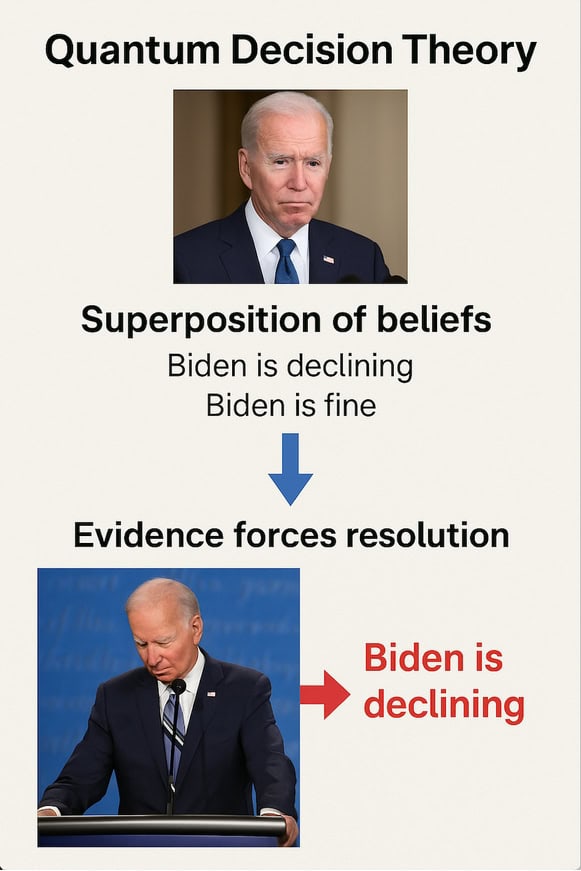
In the case of Biden, QDT sees a superposition of belief: “He’s fine” and “He’s not” coexisted in the minds of many, unresolved. Ambiguous evidence sustained the superposition. The June debate with Trump acted as the measuring event that forced a collapse of the wave function. Motivated reasoning explains why people wanted to believe; QDT explains how belief remained suspended and when it finally broke.
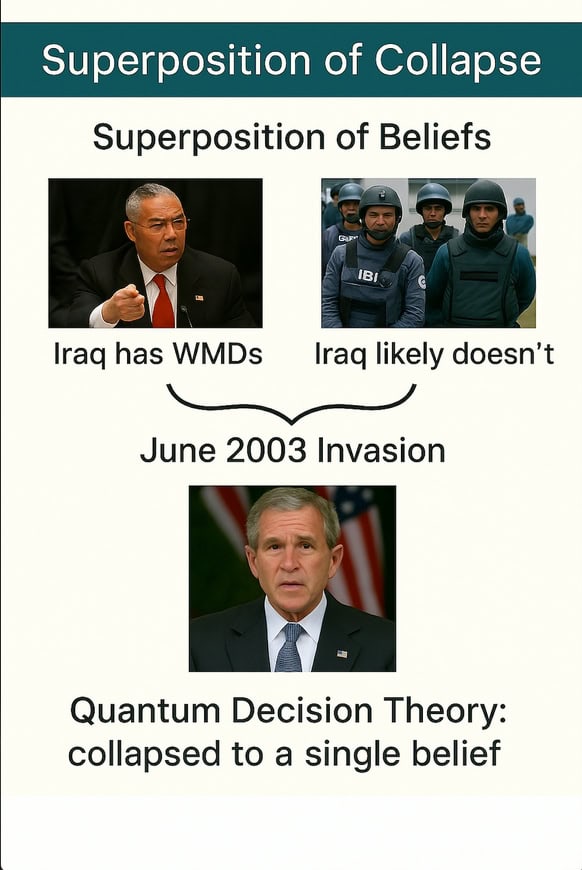
In the case of Iraq, belief in WMDs persisted despite weak evidence because the emotional and social field reinforced one outcome. Repetition from trusted sources acted as constant measurement, gradually increasing the probability amplitude of the belief. Once the invasion failed to find weapons, the accumulated counter-evidence forced a collapse. Again, not because people simply changed their minds, but because the structure of belief—long indeterminate—was finally resolved.
Cognitive bias helped us name the “what”—the patterns and distortions in behavior we once framed in binary terms: rational or irrational. But it failed to explain the “how” or “why” behind those patterns. Its foundation—rooted in outdated assumptions of linear causality and stable rational agents—lagged behind what quantum physics had already revealed: that reality itself resists simple categories, that uncertainty, context, and entanglement are not bugs in the system but features of the system.
QDT doesn’t replace psychology. It gives it architecture. It offers a framework where belief is not a switch but a field—a shifting, probabilistic terrain shaped by emotion, context, and information.
This shift in perspective matters. Climate skepticism, support for tariffs, positions on war—all of these are not just matters of logic or misinformation. They’re belief systems entangled with identity, fear, trust, and context. The same fact can yield different meanings depending on where and how it enters. We are not static observers. We are participants in the construction of meaning.
Quantum Decision Theory doesn’t pretend to solve political conflict. But it offers a model better suited to our moment—one that doesn’t assume rational certainty, but makes room for contradiction, ambivalence, and the way minds change. We are beings of potential, not certainty. Of context, not abstraction. Of thresholds, not smooth curves.
In an age of narrative fragmentation and psychological overload, this shift may be more than useful—it may be necessary. Not just to explain why people deny, rationalize, or resist, but to help us move more honestly through a world where truth is entangled, contested, and often unbearable. Physics reimagined the universe a century ago. Maybe it’s time the rest of us get on board with that reality.
Like Art's Work?

Share this Post:

Read More Posts
Mr Berman,
our knowledge of evolution is far from complete and “just so” arguments are not helpful. But as far as I know there is no conclusive evidence that evolution tries to come up with brains that are compelled to seek truth and meaning. Our complex brains seem to endowed by evolution with general purpose and flexible tools that help us with survival. General purpose flexibility does seem to be a trick that evolution has come up with, even without brains (Michael Levin). Also pattern recognition abilities are needed for immediate survival but can, as an added bonus, sometimes be used for other purposes. If a certain behavior enhances fitness (reproductive success) then it has a chance of being encoded in the genome. The model of the world that elicits such behavior doesn’t necessary have to correspond with “truth” out there. As long as it works in practice, even if it’s based on delusional insights, evolution can work on it.
It is true that we humans seem to have a thirst for knowledge and meaning. We also display a desire to transcend the natural world in which we are embedded. How can that enhance fitness? I don’t know but my guess is that these truth-seeking behaviors are based on useful illusions for better navigation through complex, fast changing environments.
If ever it will be experimentally proven that evolution designs brains, via genetic control, where absolute truth-seeking is build into the wiring of the brain I will be very surprised.
To come back to quantum-based decision making, I didn’t find any evidence for such processes in the brain. The brain is probably not a suitable environment for harboring extremely sensitive quantum processes. There is no evidence for Roger Penrose’s theory about quantum effects in microtubules.
If I have given the impression that I dogmatically adhere to certain unproven “truths”, please accept my apologies.
Ray,
Framing evolution as if it has intent is a category error—it’s not an agent, but an emergent process.
The same goes for explaining consciousness, meaning, or behavior solely through neural wiring or evolutionary advantage. That reductionist lens narrows our view rather than clarifying it.
You are not your brain. Equating awareness with brain activity reflects a deeper epistemological bias—-one rooted in linear causality, materialism, and closed-system assumptions.
Physics, neuroscience, and psychology are increasingly moving beyond that framework. The confidence with which some hold speculative models as settled truth is, in my view, part of what blocks deeper understanding.
I don’t take issue with your views personally—they’re not dogmatic, but they do sit firmly within the orthodox tradition.
All the best,
Art
Mr Berman,
it’s an interesting point of view and maybe a useful metaphor to drag quantum theory in the field of human decision making.
But I don’t think we should attach much “reality” (whatever that means) to such quantum terms as entanglement, superposition of believes, collapsing the wave function for the resolution of cognitive dissonance, when describing what goes on in human and other brains.
We didn’t evolve to discover “truth” (again whatever that means). We evolved as short term decision makers and that for very good reasons. If your survival is at stake your brain quickly decides, based on what worked in the past, what to do and try to live another day. If ever your species reaches a point where there is enough affluence and risk reduction, such as currently in large parts of the world, then your brain has the luxury to entertain all kinds of thoughts, mostly unrelated to immediate survival. I guess that musings about QDT fall into that category.
Ray,
I completely disagree. Who decided we didn’t evolve to perceive truth? Who claimed we’re hardwired only for short-term decision-making?
These are modern assumptions, not facts—-projections shaped by contemporary bias, not by the actual record of human behavior. The depth of ancient myth, oral traditions, and archaeological findings suggest our ancestors were deeply attuned to patterns, meaning, and long-range thinking—often far more so than we are now.
I’ve written a post that lays out the reasoning and evidence behind my view. You’re welcome to challenge it—-but “that’s just how evolution works” isn’t an argument, it’s a dismissal, and it’s not coming from a position of knowledge about what is actually known about that evolutionary history.
If you see it differently, write a serious response and let’s talk.
All the best,
Art
Quantum Decision, aha, so that is why people get trapped in groupthink, and take all those stupid decisions. Now we have the math to Dietrich Bonhoeffer’s Theory of Stupidity, high time to use preemptively. Bad news for most politicians:) Also, proof of why outliers often see reality far more lucidly, inverting the whole concept of “conspiracy” theory:)
Gerald,
Stupidity and cognitive dissonance are just byproducts. Groupthink is a preference held before the wave function collapses. Conspiracy theories emerge like interference patterns—-shared belief amplified in a domain where causality doesn’t apply, but people insist on forcing cause-and-effect logic anyway.
All the best,
Art
Quantum Theory in an article about Joe Biden now that is poetic license.
Okay, so cognitive dissonance is the emotional tension created by the superposition of conflicting beliefs, a kind of signal that that the ‘belief wave function’ is unstable, but hasn’t yet collapsed into a decision. I guess in this view, the cognitive discomfort isn’t a bug, it’s the energy of a suspended contradiction. We tolerate the ambiguity as long as possible, since collapsing the belief, say, for instance, admitting that climate change is real and human caused, entails unpleasant consequences and fear. So we put off the collapse as long as possible through rationalization or avoidance. Our experience of cognitive dissonance is really the sign of an unstable system awaiting a tipping point. This reframes belief itself not as fixed or binary (true/false), but as a probabilistic superposition. This view frames the operation of human cognition and decision-making as being similar (at least metaphorically) to quantum physics. Interesting stuff, Art!
Frank,
In the quantum view, there are no conflicting beliefs—just a superposition of potential ones. The mind holds possibilities until something external—a decision, an experience—collapses that state into a single outcome.
What we call “dissonance” isn’t a state of mind—it’s a reaction that comes after the collapse, when the psyche scrambles to reconcile itself with the chosen path. The idea of cognitive dissonance only exists because we still cling to the illusion that rationality governs the mind the way Newton thought it governed the universe.
But human behavior, like everything else in nature, operates within the bounds of physical law. That doesn’t mean social life is mathematically predictable—it means it can’t arbitrarily defy the constraints of the physical world.
All the best,
Art
“but it doesn’t define it”. If I may, I agree with Mark and your comment albeit I am lacking in Buddhist knowledge.
Art,
Very nice culmination of the past however many pieces.
Need to sit for while with the thought of stated preference as a field, susceptible to what we expose it to. Opens quite a bit of secondary/tertiary inquiry.
Thanks,
Mark Henry
Thanks Mark Henry,
If we lack a coherent worldview—one that speaks to the nature of reality, the relationship between thought and the world, and where the individual fits within it—how can we possibly know what we want?
I hesitated to add another layer to an already complex subject, but the truth is, quantum theory offers no definitive account of what reality actually is beneath the surface of matter. It gestures toward something deeper, more relational, more unknowable—but it doesn’t define it. That’s the work of philosophy, a field we’ve largely sidelined in a world built on reductionism and utility.
And yet without that grounding, our preferences—stated or otherwise—float untethered.
David Bohm and Iain McGilchrist offer the clearest guidance in the western world. Buddhist practice had this figured out 2000 years ago.
All the best,
Art