
The Deep State Myth as a Symptom of Systemic Collapse

The “deep state” isn’t real—there’s no smoky backroom of rogue bureaucrats plotting to subvert democracy. But there is a sprawling, entrenched bureaucratic apparatus that frustrates elected leaders, slows agendas, and seems impervious to change. That’s not conspiracy—it’s what happens when government scales to complexity.
The “deep state” has become a cultural emblem: liberals dismiss it, conservatives blame it. But both responses miss the point. It isn’t a cabal; it’s a metaphor. It captures the sense of disconnection people feel from a government that no longer seems accountable or intelligible. It’s a distortion of reality, but the discontent it expresses is real.
Peter Turchin offers a structural explanation. Studying 60 civilizations, he observed a recurring pattern: as societies grow, they produce more elites than positions of power can accommodate. Lawyers, bureaucrats, media influencers, ideologues—they accumulate. Conflict follows. These ambitious contenders don’t fade away—they fight over influence.
This is elite overproduction. The surplus drives intra-elite competition: a brawl among credentialed, networked actors who command capital, information, or institutional access. In the U.S., elites operate through elected figure heads, lobbying, media, and bureaucratic levers. They shape outcomes from inside the machine.

On one side: the technocratic elite—executives, financiers, data tycoons. Think Bezos, Musk, Zuckerberg and Thiel. On the other: the nationalist-populist faction—fossil fuel barons, security hawks and real estate kingpins. These factions don’t share a vision. They share a battleground.
JD Vance’s rise, the Musk-Trump feud, and DOGE’s collapse all illustrate this fracture. Vance represents the insurgent elite—younger, disillusioned, spoiling for institutional war. Musk, once an ally of Trump, now clashes with him in public—a textbook example of elite fragmentation. DOGE was their project to dismantle the bureaucracy; instead, it revealed how deeply rooted that structure is.
This isn’t a revolution. It’s a palace fight. And the public is caught in the crossfire.

The administrative state—the target of so much rage—is not the deep state. It’s the plumbing of governance. Bureaucrats don’t set policy; they administer it. They are not elites. They’re functionaries. To blame them is to mistake the gears for the engine.
Calling it a “deep state” is dishonest. It papers over the real issue: a civil war within the elite, with each side invoking “the people” while battling for control of the state. The prize isn’t the next election. It’s control of the machinery itself.
Bureaucracy, from a systems view, is not failure—it’s adaptation. As societies scale in population, laws, regulations and interdependence, bureaucratic structures evolve to manage that complexity. They buffer volatility, maintain continuity, and absorb overload. But when trust erodes and institutional responsiveness lags, that buffering looks like obstruction.

Source: Labyrinth Consulting Services, Inc.
We are in a moment of systemic failure. Institutions designed for a different era no longer match the pace or complexity of today’s challenges. Feedback loops have broken down. The system isn’t working—not because of corruption or incompetence, but because it’s structurally misaligned. Waste and fraud exist, but they’re symptoms, not the root cause.
This whole architecture was built on cheap, abundant fossil-fuels. Bureaucracy was the scaffolding of modern prosperity. But now, as energy constraints tighten, its structure becomes harder to maintain. The political fractures are early warnings. Deeper structural breaks are on the way.
The administrative state is now both vital infrastructure and scapegoat. It keeps society running—and gets blamed when it stalls. That’s why the deep state myth sticks. It isn’t factual. It’s emotionally true. It explains why people feel stuck in a system that doesn’t respond.
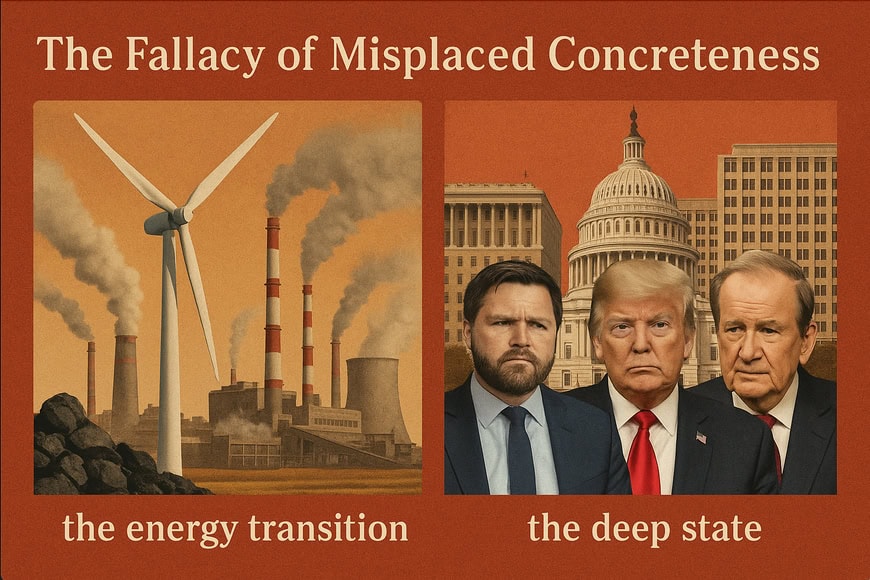
This is the fallacy of misplaced concreteness: treating abstractions like concrete things. “The deep state” isn’t a thing—it’s a story. A way to name frustration with bureaucracy, inertia, and opacity. But the more we believe the story literally, the further we drift from understanding the problem.
Source: Labyrinth Consulting Services, Inc.
Energy transitions, too, fall into this fallacy. We talk about them as linear shifts—from fossil fuels to renewables—as if they were clean replacements. But history shows otherwise: we don’t replace energy sources; we stack them. Coal use hasn’t vanished—it’s grown. Renewables aren’t replacing fossil fuels. They’re being added to the pile.
The deep state myth flattens complexity into villainy. It offers a clear enemy where there is only misalignment—a system of institutions that haven’t adapted to the scale, speed, and strain of modern life. That lag breeds distrust. And into that void, narrative rushes in.
But the answer isn’t demolition or denial. It’s recognizing that what we’re living through isn’t unique. It’s part of a recurring historical pattern. The names change, the technologies shift, but the structure remains: the system strains under its own weight. What we call “crisis” is often just the late stage of a familiar cycle.
Governance failure is one of the most immediate risks of the coming decade—on par with financial breakdown, war, supply chain fragility, and ecological collapse.
This isn’t just an American story—it’s a global pattern. Institutions built for a different world are buckling under the strain of ecological, energetic, economic, and informational pressures. The deep state myth is just one way people try to make sense of systems that no longer feel responsive or intelligible. But the real task isn’t exposing conspiracies—it’s rebuilding coherence in a world that’s outpaced its own infrastructure.
I don’t expect this will be done collectively, or even consciously. Most people won’t care until it’s too late. I’m writing for a different kind of elite—not the ones chasing power, but those trying to understand where we are, and what might still be possible. If there’s any path forward, it lies in building small, authentic communities—pockets of trust and awareness that can endure the noise.
Confusion and friction will grow. More myths will rise to explain the cracks. But as Ilya Prigogine reminds us, even at the edge of chaos, islands of coherence can persist. The work is to find them—or build them—before the tide comes in.
Like Art's Work?

Share this Post:

Read More Posts
You have raised an important point about envy that is particularly significant during periods of stagnation and retrenchment. In Australia, it is common to talk about “public service fat cats” although having worked in the public sector I can tell you that most cats are skinny; but they do have (or had) tenure and retirement benefits. An outcome of this scapegoating is periodic purges of the public sector which the right of politics sees as a wholesome project. The result is that corporate memory is eroded which enfeebles the ability of the bureaucracy to provide insightful and independent advice which further degrades the opinion of observers to the bureaucrats.
Peter,
My experience in large companies was that purges/reorganizations always reduced the ability of the organization to function for months or years, and wasted a lot of money because people were distracted from the business of the company. Governments are different from companies but I suspect the net result of reorganizations is similar. It’s all about politics and optics instead of honestly expecting better outcomes.
The current DOGE effort in the U.S. may have found $80-$90 billion in verified savings. The government spends $18.5 billion per day so it’s a complete waste of time IMO.
All the best,
Art
well done, I have friends who ramble on about the deep state and when I ask them who is in the deep state, they cant answer me. this explains why they cant answer me.
Daniel,
Thanks for your comments. People would rather blame anything–even if it doesn’t exist–than acknowledge that complexity is the problem because it has no solution that includes growth.
All the best,
Art
Agree that it is a problem World wide but that interesting variations arise in different countries.
In the UK there has been a general following of trends that arise in the U,S.A. but in a couple of respects it can differ. Before the last election, people who supported left or right generally supported the re-nationalisation of the franchised rail operating companies (the railtrackcompany) had been re-nationalised back in I think 2002. This might seem odd as in reality it is an extension of the state but corporate ownership was seen as a failure, fragmenting a system best run as a whole, plus railworkers traditionally are held in high regard. The same widespread agreement is held regarding water companies being taken into state ownership, although it will not happen unless they fail.
I do get the impression that in the US the treatment of air traffic controllers is seen as endangering travellers and that possibly the majority see this as a retrograde step?
But is the base feeling partly dressed up as a mistrust of the deep state but is in part a jealous reaction to stable work, pension or health benefits that government workers receive and that have been disappearing from large swathes of the economy. Because the economy is failing more and more people.
J,
Everything is breaking down for most people. By the end of 2026, half of working Americans will have a gig job just to make ends meet. And that’s not even the worst of it—far from it.
Meanwhile, politicians stay busy perfecting the art of blame.
All the best,
Art
You have raised an important point about envy that is particularly significant during periods of stagnation and retrenchment. In Australia, it is common to talk about “public service fat cats” although having worked in the public sector I can tell you that most cats are skinny; but they do have (or had) tenure and retirement benefits. An outcome of this scapegoating is periodic purges of the public sector which the right of politics sees as a wholesome project. The result is that corporate memory is eroded which enfeebles the ability of the bureaucracy to provide insightful and independent advice which further degrades the opinion of observers to the bureaucrats.
Art, as a retired ex Shell exec, I normally agree with you on all aspects of energy. In this case I think that the US Government and the associated bureaucracy have grown way beyond our needs and is now a behemoth that feeds itself at our expense. Less government and intrusion into our lives would be a big improvement.
Manfred,
I agree that government has grown too large, but you can’t view that growth in a vacuum. Its expansion tracks with a doubling of the population since 1953 and a massive increase in laws, regulations, court rulings, tax code revisions, and executive orders. These don’t disappear once passed—they require oversight and enforcement, which fuels bureaucratic growth.
You can’t let society spiral into ever-greater complexity and expect its management to stay simple or streamlined. Bureaucracy is the inevitable consequence.
Best,
Art
Intra-elite infighting does not exclude the existence of “deep state” like mechanisms. Why else send your kid to Eton, aspire Skull and Bones membership, attend YGL Programmes, and set up organisations like the Atlantic Treaty Association and invite-only Bilderberg Conferences? Their alumni lists make it abundantly clear: power must always remain within a limited in-crowd. WHO, NATO, IMF, World Bank, EU-bureaucracy, etc… are all, cleverly by design, intra-national entities on which their democratic constituents have zero influence over, yet increasingly dominate their everyday lives. Complexity is an ideal mask for hiding true intentions. MBSes and CDOs are prime examples.
Gerald,
You seem to have missed the point of the post entirely. Bureaucrats aren’t Ivy grads or ruling class insiders—they’re middle-class professionals with modest pay and zero fame. They enforce regulations, process benefits, and keep the machinery of government grinding.
Write your own post.
Art
Very insightful article.
When the system starts contracting, that’s one of the logical side-effects one can expect.
No longer enough to accommodate all the aspiring elites who all want their seat at the trough can turn them into very angry and hungry piggies.
Thanks for your comments, Ray.
All the best,
Art
Good morning, Art,
Thanks for the well-thought-out article. I completely agree with your thoughts that there is no conspiracy among the elite – that they are too busy competing to cooperate.
I would really like to see you expound on the last two paragraphs of this article. I’d like a little more explanation on what you mean by:
– Building small, authentic communities
– Pockets of trust
– Islands of coherence
Your friend,
Hal.
Hal,
I recommend this podcast with Iain McGilchrist and Nate Hagens:
https://www.thegreatsimplification.com/episode/165-iain-mcgilchrist
All the best,
Art
Art,
Have you read The Matter With Things: Our Brains, Our Delusions, and the Unmaking of the World? It has been on my stack for a few months, but I have avoided it for one reason or another. Each time you bring up Iain, I feel like a horse being spurred.
Thanks,
Mark Henry
Mark,
Yes. It’s the most important work of philosophy since Whitehead.
Best,
Art
Totally agree!
And wouldn’t it be nice if a tiny fraction of our remaining energy and material resources could be devoted to supporting and “building small, authentic communities”, mostly in rural areas, where they could be better prepared for the coming breakdown of modernity. Of course there are many small, low-energy agrarian communities in the Global South that are about as ready for modernity’s end as anyone can be, but nothing is being done to keep them protected from global market forces as those forces expand everywhere.
There are billions of dollars sloshing around in tech mogul’s pockets and government budgets, but none of them are devoted to any kind of realistic preparation for what is to come, either by supporting sustainable communities that already exist in poorer countries or by creating new ones in richer countries. It’s really a shame.
Joe,
Most tech moguls believe that tech will solve all of the world’s problems.
Best,
Art
Hello Mr. Berman.
I like your article and I agree.
All of this reminds me of a certain resemblance to the Roman Empire, when the empire was no longer conquering enough to seize the wealth of subjugated peoples and slaves.
The elites, due to a lack of wealth, fought over how to distribute it among themselves, causing tensions.
Romain,
Peter Turchin documents those factors for Rome and many other states over the last few thousand years.
All the best,
Art
Brilliant and important analysis and insights, Art! Thank you.
Thanks, Doug.
It’s good to hear from you!
All the best,
Art