
America Has Plenty of Oil—Just Not the Right Kind
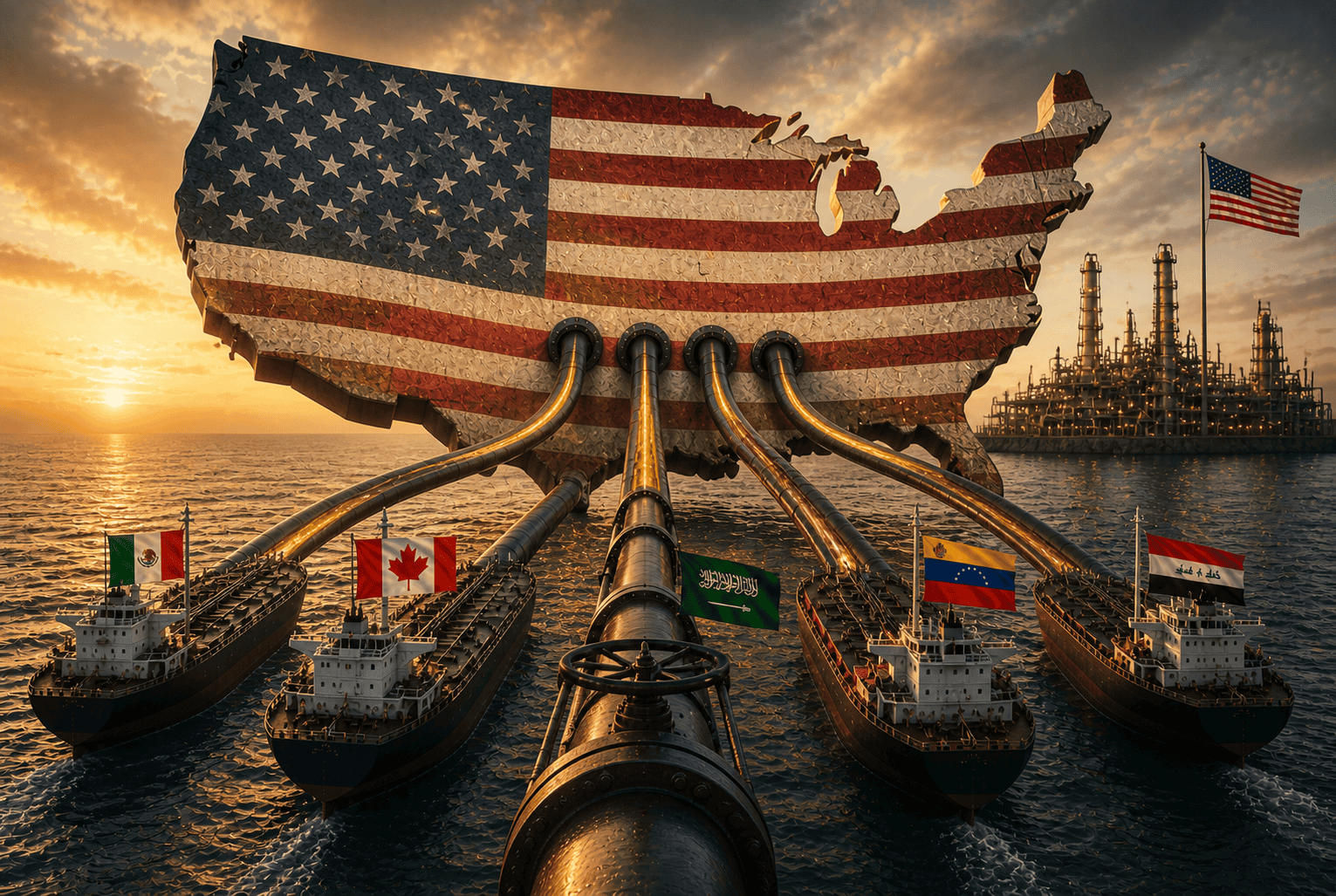
The U.S. is not energy independent—and cannot be—because oil quality matters. The U.S. has plenty of oil. A lot of it’s just not the right kind.
The U.S. now produces more oil than Saudi Arabia and Russia combined, and as much natural gas as Russia, Iran and China combined. That’s the headline from a recent Department of Energy release—complete with charts that imply political leadership is responsible for the surge (Figure 1).
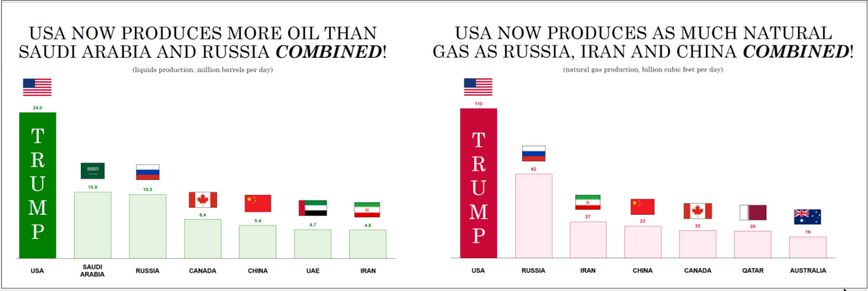
The numbers are technically correct—and deeply misleading.
Production alone says very little about a country’s underlying energy position. Saudi Arabia holds roughly four times more oil reserves than the United States, and Russia about 1.5 times as much. For natural gas, Russia has nearly three times U.S. reserves, and Iran more than 2.5 times.
Production is a flow. Reserves are the stock.
Producing more today means depleting faster tomorrow. It’s not dominance. It’s draining America first.
Yet the belief that the United States is “energy independent” persists, reinforced by official statistics.
The United States has been a net total energy exporter—total energy exports have been higher than total energy imports—since 2019.
That statement is also technically correct—and just as misleading.
It aggregates crude oil, refined products, natural gas, coal, and electricity into a single heat-equivalent metric. In doing so, it collapses fundamentally different energy forms with different end uses into one number and obscures a critical reality: the United States still depends on imports of specific fuels—especially heavier crude oil—to keep its energy system running.
That distinction matters because oil still dominates U.S. energy, accounting for nearly 40% of the total (Figure 2).
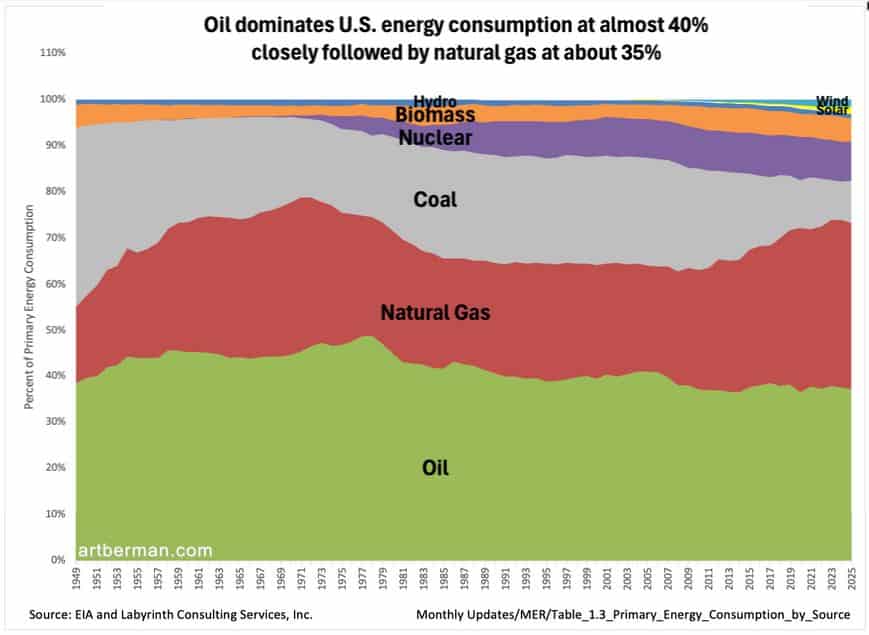
closely followed by natural gas at about 35%.
Source: EIA and Labyrinth Consulting Services, Inc.
Oil is not just another fuel—it’s the economy. It powers transport, agriculture, mining, and construction, and it underpins global trade. Most goods either contain oil or depend on it somewhere in their supply chain. When oil flows smoothly, the economy functions. When it doesn’t, everything slows, breaks, or gets more expensive.
The United States remains a substantial net importer of crude oil. Imports averaged about 6.3 million barrels per day in 2024 and 2025, while exports were only about 4.0 million barrels per day (Figure 3).
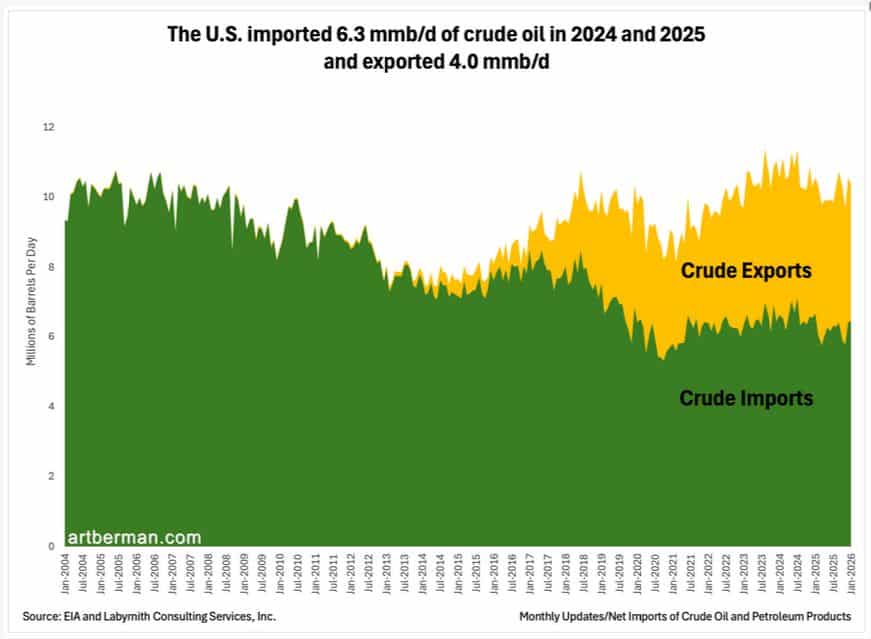
Source: EIA and Labyrnith Consulting Services, Inc.
Why does the U.S. both import and export large volumes of crude oil?
Because not all oil is the same.
The terminology doesn’t matter. The mismatch does.
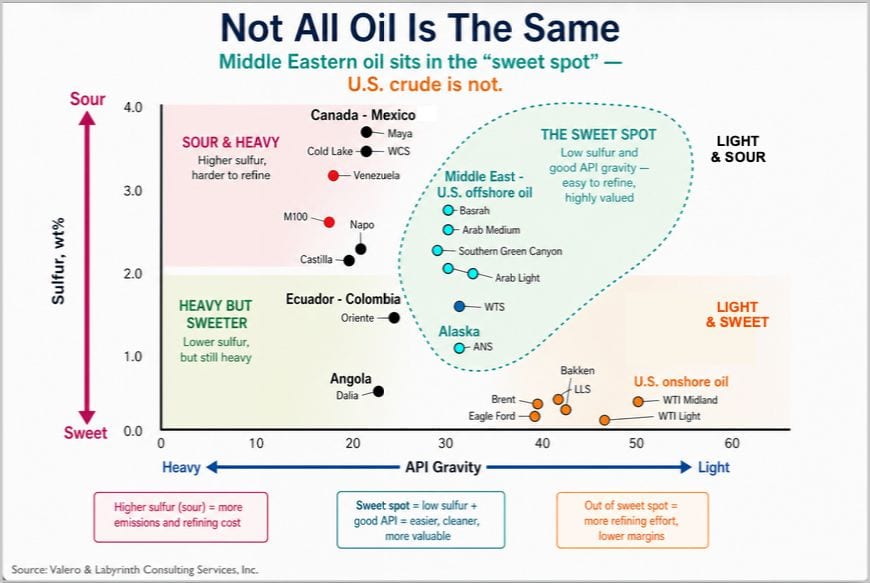
Most U.S. production is light and sweet (Figure 4). Many U.S. refineries, however, were built to meet strong demand for diesel and jet fuel, which require heavier, sour crude in the blend. They were designed to run that heavier oil alongside lighter barrels. The shale boom flooded the system with light, sweet crude that refineries weren’t configured to fully absorb, creating a persistent surplus. That’s most of what the U.S. exports.
Middle Eastern oils sit near the global “sweet spot”—balanced in a way that allows refineries to produce gasoline, diesel, and jet fuel efficiently with minimal adjustment (Figure 4).
Source: Labyrinth Consulting Services, Inc.
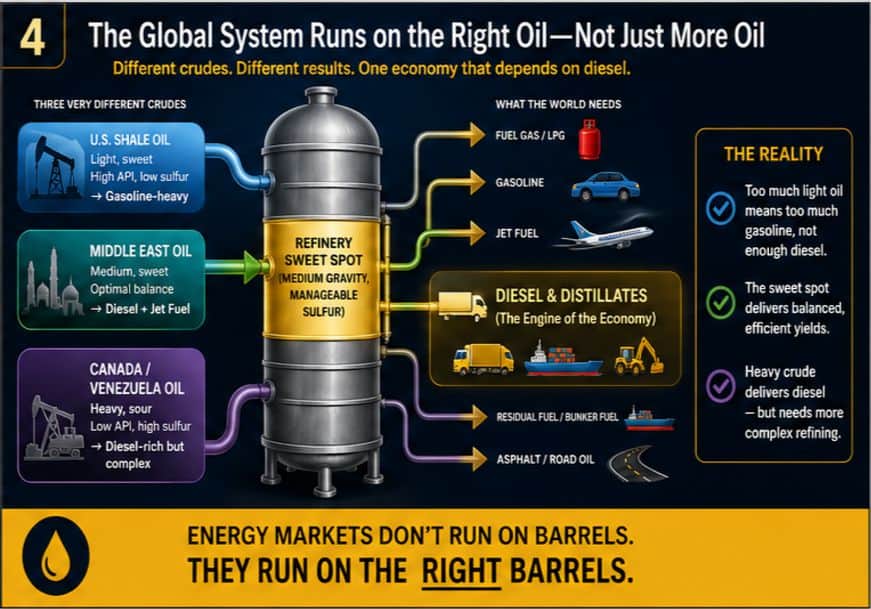
Figure 5 shows how most global refineries actually operate. They use some light oil like U.S. shale and some heavy oil like Canadian or Venezuelan crude, but the backbone of the system is medium-grade oil from the Middle East. Each type works—but not on its own. Refineries run a crude “slate”: a carefully balanced blend designed to yield the right mix of products.
The United States uses as much of its own light oil as it can, exports the surplus, and imports heavier crude—mainly from Canada—to complete that blend. This isn’t a contradiction. It’s a structural necessity.
Source: Labyrinth Consulting Services, Inc.
The bottom line is simple.
The global oil system runs on the right oil, not just more oil.
Even as the world’s largest producer, the United States still depends on imports—not because it lacks oil, but because it doesn’t produce enough of the right kind.
This isn’t a partisan issue. It’s a physical one.
“Energy independence” is not a physical reality. It’s an accounting artifact.
As long as the U.S. requires foreign crude to make its refineries work, it’s not independent—no matter what the statistics say.
Like Art's Work?

Share this Post:

Read More Posts