
Oil, Power, and Statecraft: The Geopolitics of Energy in a Changing World

The Assad regime collapsed early Sunday following a rebel offensive that captured Damascus, ending five decades of authoritarian rule. The Hayat Tahrir al-Sham (HTS) insurgents, led by Mohammed al-Julani, encountered little resistance from the Syrian army during their rapid advance into Damascus. The Iranian Embassy in the capital was ransacked, suggesting it had been abandoned prior to the rebels’ arrival.
Israel’s assassinations of Hamas leader Ismail Haniyeh in July, and Hezbollah’s Hassan Nasrallah in September, along with its military offensive in Lebanon, triggered these events that have significantly altered the region’s power dynamics.
Syria’s collapse raises key questions about the Middle Eastern power structure. As an ally of Iran and Russia, Syria was critical for maintaining supply lines to Hezbollah in Lebanon, underscoring its strategic importance in the region. Iran’s supply “land bridge” through Syria and Iraq stems from a decades-long strategy of supporting proxy groups (Figure 1). The Islamic Revolutionary Guard Corps (IRGC) orchestrates this strategy by supporting Hezbollah in Lebanon, Hamas in Gaza, and Yemen’s Houthis to destabilize pro-Western Arab states and undermine Israel.
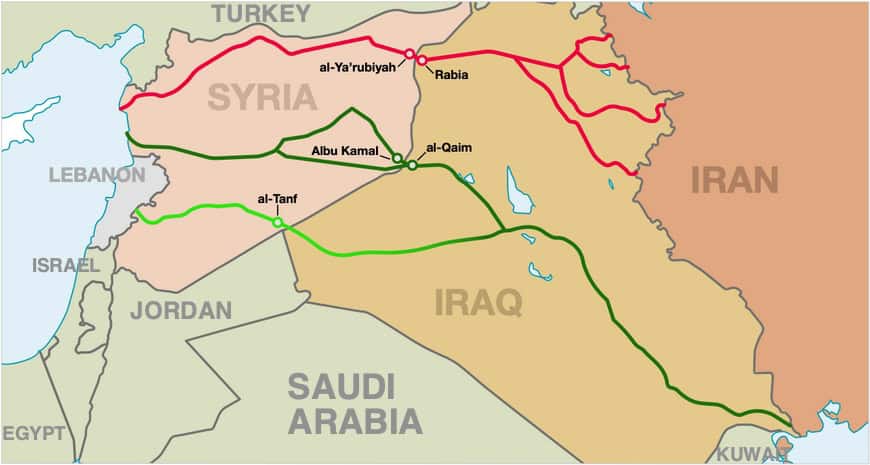
The collapse of Iran’s land bridge supply lines could reshape the dynamics of the Israel-Hamas-Hezbollah conflict and undermine Iran’s regional power. This in turn links to the Ukraine war and broader global geopolitics, including China’s quest for oil security. Russia has now lost its only position of power in the Mediterranean which it gained in 2015.
Syria may lack significant oil reserves, but in the Middle East, nearly everything ties back to oil. This underscores the need to reassess U.S. foreign policy, especially with Donald Trump signaling aggressive stances toward Iran and China in his upcoming second term.
Some have suggested that the world is moving back to mercantilism, and that Trump’s protectionist policies and rhetoric are consistent with this shift. His “America First” stance, withdrawal from the TPP (Trans Pacific Partnership), and push for border taxes mark a departure from the global free-trade consensus. At the same time, China’s bid to lead the new RCEP trading bloc, the growing BRICS Group, and a greater willingness by governments to intervene in markets all underscore a changing trade landscape that increasingly resembles mercantilism.
John Authers echoed many of those themes in his recent article “A New World Order Is Here, and It Looks a Lot Like Mercantilism.”
“You’re left with a steady shift away from Friedmanite capitalism and even Keynes toward a new model with a larger welfare state, trade blocs protected by tariffs, and a government that can enforce its priorities on companies. Protectionism has returned, but the financial sector remains unshackled. Trump’s return ratifies an existing order.”
Authers is right, but the return-to-mercantilism story overlooks the central role of energy. Oil reshaped trade, geopolitics, and economic control, transforming the old mercantile framework. Its importance to industrialization, transportation, and military power made energy security the foundation of modern global strategy.
The United States’ dominance in global power stemmed from its early recognition of oil’s central role in shaping the modern world.
“The cry that echoed in August of 1859 through the narrow valleys of western Pennsylvania—that the crazy Yankee, Colonel Drake, had struck oil—set off a great oil rush that has never ceased in the years since. And thereafter, in war and peace, oil would achieve the capacity to make or break nations, and would be decisive in the great political and economic struggles of the twentieth century.”
The core logic of mercantilism—control resources, dominate trade, and accumulate wealth—remains. But oil rewrote the rules of statecraft entirely. Nations and corporations fought for control, driving military interventions, technological advances, and economic systems built around oil dependency and its role in industrial power.
The Two World Wars Were Won Because of Oil
The U.S. dominated oil production during both World Wars, supplying over 70% of the global total. Germany’s oil shortages sealed its fate in World War I, while inadequate fuel crippled both Germany and Japan in World War II (Figure 2).
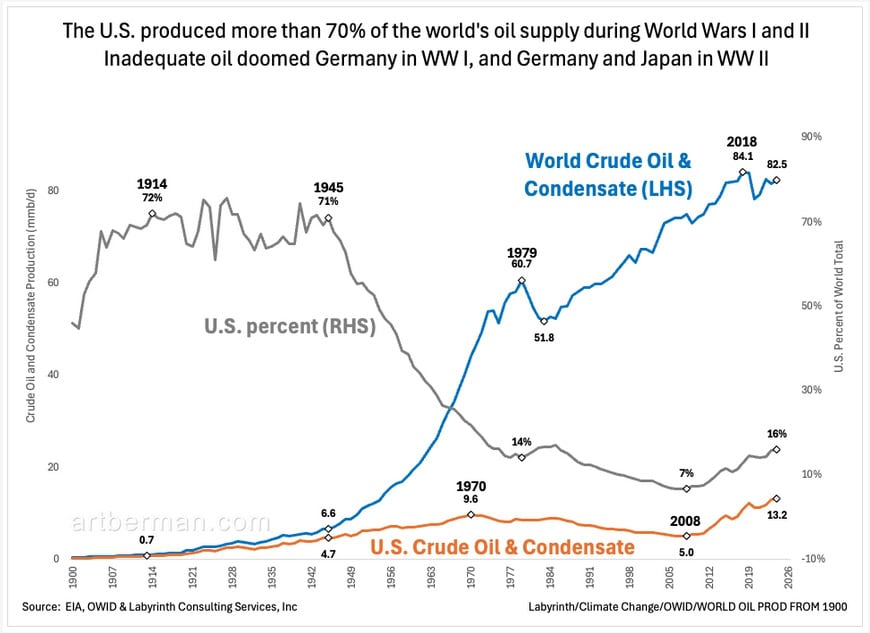
Germany lost World War I largely due to its inability to secure adequate oil supplies. Germany failed to scale Romanian oil production to sustain its 1918 Spring Offensive. Its forces stalled at the Somme for lack of fuel. In contrast, Allied troops, fueled by American gasoline, maintained their momentum. After Germany’s 1918 defeat, Britain’s Lord Curzon summarized it: “The Allies floated to victory on a wave of oil.”
Inadequate oil supply similarly doomed both Germany’s and Japan’s efforts in World War II. The Battle of the Bulge in December 1944 was Germany’s desperate bid to turn the Ardennes into its “biggest gas station,” aiming to seize Allied fuel and sustain its faltering war effort.
“With the failure of the Ardennes offensive, Germany’s war effort, from a strategic point of view, was over.”
In the Pacific, U.S. submarines disrupted Japan’s oil supply by sinking tankers and cutting off shipping routes. Fuel shortages crippled Japan’s navy, grounded its air force, and strained its economy. By the war’s final year, Japanese planes could barely fly two hours a month.
U.S. Foreign Policy Lost Its Way
U.S. foreign policy in the first half of the 20th century prioritized oil security in the Middle East, despite America’s status as the largest producer and energy-independence through and after both world wars. A key principle was avoiding military entanglements in the region. George H.W. Bush broke that rule by sending troops during Iraq’s invasion of Kuwait in 1991.
George W. Bush compounded the error, occupying Afghanistan in 2001 and Iraq in 2003. The energy blindness of the Iraq invasion was especially perplexing—the U.S. was so obsessed with state building that it failed to secure Iraq’s substantial oil resources. Worse, it disrupted the carefully managed balance of power that had defined U.S. strategy for decades, paving the way for Iran’s rise as a dominant force in the Middle East.
Barack Obama deepened the missteps by sidelining the long-standing security partnership with Saudi Arabia to pursue a nuclear deal with Iran. When Iran’s Houthi proxies attacked Saudi Arabia’s key refinery complex in 2019, Donald Trump didn’t even extend formal condolences. Trump’s withdrawal from the Iran nuclear agreement and his poorly executed “maximum pressure” sanctions strategy backfired, causing massive investor losses in oil markets. This eroded confidence and led to a wave of capital flight from the U.S. oil industry.
Can the United States Reset?
Now, President-elect Trump plans to pursue a “drill-baby-drill” policy to boost domestic oil production. This is in direct conflict with oil company strategies aimed at regaining investor trust lost in Trump’s first administration and it ignores the physical limits to U.S. reserves.
The United States may be the world’s largest oil producer, but it’s a third-rate player when it comes to reserves. U.S. oil reserves are less than half those of Iran or Iraq and only about two-thirds of what Russia, Kuwait, or the UAE hold (Figure 3). The future of oil isn’t “America first”; it’s the Middle East first—just as it’s always been.
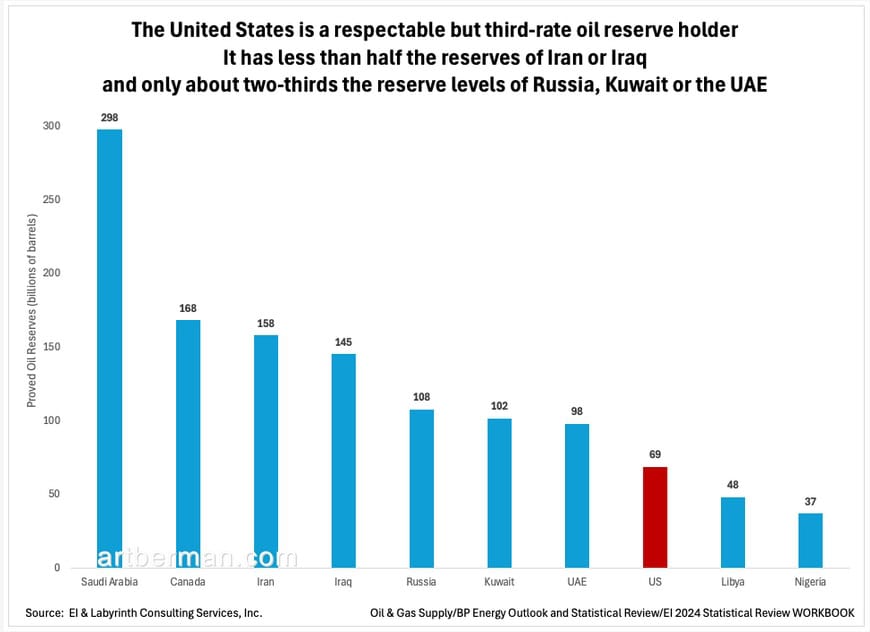
China doesn’t even make the chart for oil reserves. It’s the world’s largest importer, an “oil have-not,” which is a critical weakness for a nation aspiring to lead in military power. Armies, navies, and air forces run on oil, not EVs.
Eighty percent of China’s oil imports travel by sea, crossing the Indian Ocean and the vulnerable Strait of Malacca—choke points the U.S. Navy could easily block. Chinese strategists have long feared that the U.S. could sever these lifelines, crippling China’s economy and its ambitions.
An expansionist power needs far more oil than a status quo state, and China has a petroleum deficit that is likely to worsen over the next few decades. China’s current trajectory suggests that an alliance-based oil security strategy could be in the cards.
Currently, Iran and Russia together account for about 40% of China’s crude oil imports.
“In 2017, China opened its first-ever overseas naval base in Doraleh, Djibouti, on the Bab-al-Mandeb Strait linking the Indian Ocean to the Red Sea. The base is expected to house as many as ten thousand Chinese troops, along with ammunition stores, maintenance facilities, a midsize airfield, and other logistical support materials.”
Kelanic further notes that China is building up to 18 dual-use ports in the Indian Ocean to secure energy routes and boost its military presence. It is also deepening ties with key brick-and-road partners like Pakistan, critical to its oil supply chain.
Meanwhile, Donald Trump intends to maintain Biden’s tariffs on Chinese exports, signaling continuity in the U.S. stance on trade tensions with China. Why this emphasis on mercantile issues when oil is the real basis of power?
Biden’s Inflation Reduction Act, aimed at reindustrializing America as a renewable energy competitor to China, misses the mark. Let’s be clear: China’s push for dominance in renewables and electric vehicles isn’t about climate change—it’s about energy security. As an oil have-not, China sees renewables as its only path to reduce dependence on oil imports. The same applies to Europe.
The U.S. is unlikely to beat China in the renewables race, so why try? Let China take the lead while America focuses on its strengths—oil and natural gas—and rebuilds ties with key Middle Eastern producers. Power in the 19th century was about manufacturing; in the 20th and 21st, it’s about oil. I wish this weren’t true from an ecological standpoint, but geopolitics demands a clear-eyed, pragmatic approach.
What About Ukraine and Europe?
Which brings us to Europe, Russia, and NATO. John Mearsheimer captures the narrative held by Tulsi Gabbard, Trump’s pick for Director of National Intelligence: the U.S. provoked Russia’s invasion of Ukraine by pushing NATO and EU expansion while steering Ukraine toward a pro-American liberal democracy. He points to NATO’s 2008 Bucharest Summit, where plans to include Ukraine and Georgia crossed what Russia viewed as an existential red line.
The story makes sense up to a point but notably ignores energy as a factor. Natural gas was central to tensions leading up to the Ukraine war because Ukraine has long been the principal pipeline path to Europe from Russia (Figure 4). Additionally, Russia’s push to export LNG has been central to its strategy in Ukraine, both before and after the invasion.
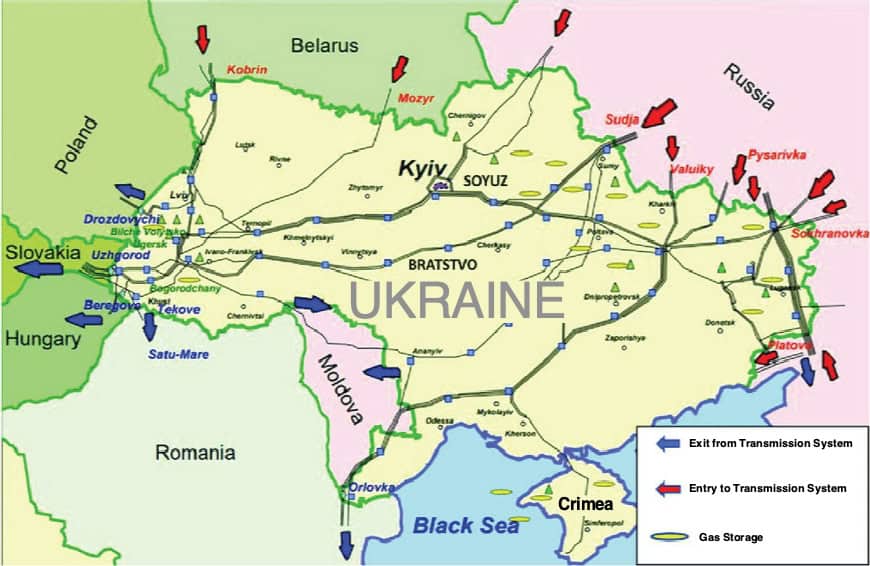
Russia’s 2014 annexation of Crimea blocked Ukraine’s push for energy independence and kept it reliant on Russian gas. It was a calculated show of force, reinforcing Moscow’s control and sending Europe a clear message about its dependence on Russian energy.
Russia’s 2022 invasion of Ukraine was a bid for territory. Putin aimed to neutralize Ukraine’s defenses and annex Russian-speaking regions in the east. Instead, it was a disastrous miscalculation. Putin underestimated Urkaine’s military resolve and the West’s unity over Ukraine—he mistakenly bet Europe wouldn’t risk sanctions due to its gas dependency. Instead, Russia lost its European gas market—a costly economic mistake.
This post is about oil, not natural gas, but the point is the same: modern geopolitics almost always comes back to energy. That said, it’s doubtful that Russia ever intended to occupy all of Ukraine. The idea of a domino effect of Russian aggression sweeping Eastern Europe is overblown.
Given Russia’s struggles against Ukraine—a country with limited military capability—it’s hard to imagine it taking on a real European military power, let alone risking direct conflict with NATO.
“Western leaders…have frequently framed the invasion of Ukraine as the first step in a Russian plan of broader European conquest. However, a close examination of Russian intent and military capabilities shows this view is dangerously mistaken.
Russia likely has neither the capability nor the intent to launch a war of aggression against NATO members — but the ongoing brinkmanship between Russia and the West still poses serious risks of military escalation.
From A Patchwork to Statecraft
For 75 years, Europe has distracted U.S. foreign policy from oil, draining American resources at an unreasonable cost. If Russian aggression is appropriately discounted, the hard truth is this: Europe’s primary strategic value to the U.S. lies in being a strong market for American oil and natural gas. Donald Trump is likely right that Europe should handle more of its own issues.
Repairing ties with Russia and accepting a limited return to Russian natural gas makes more sense than the path Europe is on—a downward spiral of deindustrialization fueled by unrealistic ambitions of a renewable future. Risking nuclear war over Europe’s disputes with a third-rate economic and military power—nuclear-armed or not—is plainly unreasonable.
In the early 2000s—before China’s rise, the U.S. disasters in Afghanistan and Iraq, and the 2008 Financial Crisis—America’s undisputed dominance made idealistic foreign policy seem plausible. That era is over. The world is more contentious now, and it’s time to replace outdated ideological ambitions with more practical approaches to foreign policy.
My colleague Michael Every makes a compelling case for economic statecraft based on realism in a multi-polar world versus economic policy based on idealism in a more unipolar world.
He explains that economic policy works in an idealistic, cooperative world. But when realist powers step in, the rules change. Economic statecraft takes over, spreading realism across the geopolitical map. Realism deals with hard truths; idealism clings to hope.
“Today, one should start by asking what a state’s key interests are in a challenging geopolitical environment; what its grand strategy is; then considering if this can be achieved best with economic policy, or idealist or realist economic statecraft.
“Finally, one asks what GDP and associated macro variables and market forecasts will be in that environment. Clearly, this approach differs from the output from static, purely economic models.
“A more geopolitical world, by definition, should arguably preclude sole reliance on business-as-usual economic or market thinking.”
He asks, “What is GDP for?” It’s a question I don’t recall hearing before. GDP isn’t just a metric for progress—it should serve as a means to an end, not the end itself.
Helen Thompson has insightfully noted that the last decade’s disruption is often blamed on populist nationalism, the 2008 crash, and the decline of a liberal international order. What’s missed is the central role of energy in shaping the geopolitical and economic fractures.
Statecraft in the modern world should be framed around the primary driver of political power—oil.
If China is the main challenge to U.S. interests, why not focus on America’s strengths and China’s vulnerabilities? Shale has given the U.S. an advantage in oil, while China faces a significant and enduring oil deficit. Why is the U.S. sending China 400,000 barrels per day of oil and petroleum products to fuel its military (Figure 5)?
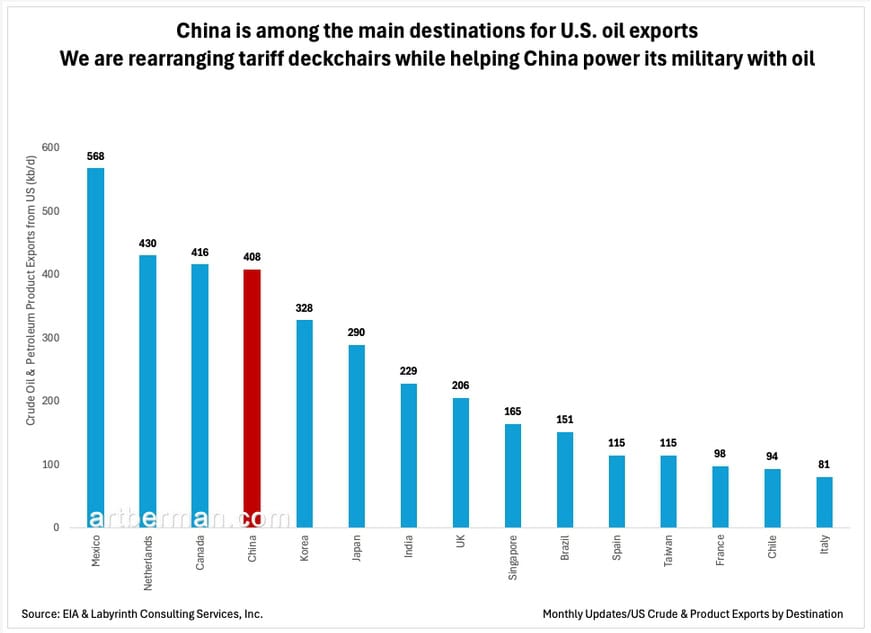
We are rearranging tariff deckchairs while helping China power its military with oil.
Source: EIA & Labyrinth Consulting Services, Inc.
Instead of waiting for China to address its energy vulnerabilities, the U.S. could threaten “maximum pressure” by restricting oil exports and targeting Russian and Iranian supplies. This strategy could cut China’s oil supply by up to 5 million barrels per day.
The real risk lies in potential retaliation, such as a blockade or attack on Taiwan’s semiconductor industry. Statecraft could turn this into an opportunity—leveraging oil for chips and negotiating broader agreements to reduce tensions and foster more productive outcomes between the two nations.
Tariffs are the wrong tool—they hurt the U.S. economy more than they help, and are an artifact from an economic system that has passed. This is not about outdated mercantilism; it’s about recognizing oil’s central role.
Let China dominate the production of solar panels, wind turbines, and EVs. The U.S. can’t compete anyway. Those industries, while important, are no substitute for oil in the balance of power. Armies, navies and air forces run on petroleum, not electricity.
The solution to future U.S. oil supply isn’t doubling down on domestic drilling, as Trump suggests. It’s about leveraging U.S. technological strengths and building alliances with the major reserve holders—Saudi Arabia, Iraq, Kuwait, the UAE, and even Russia. Results will vary, but the first step is acknowledging the need and recalibrating stratecraft to meet it.
This isn’t a policy prescription—I’m not a policy expert, but I understand energy. Any realistic economic strategy must put energy at the center, yet I see leaders enacting policies stuck in a mercantile framework that ended 75 years ago.
What I’m suggesting is pragmatic—call it Machiavellian if you like. I’m willing to set aside my deeply held environmental concerns, at least temporarily, to entertain a thought experiment. The idea is to begin with the extreme and work backward toward balance because the current trajectory leads inevitably to political, economic, and environmental disaster.
Decades of climate summits and initiatives have done little to alter humanity’s dangerous trajectory. As my friend Nate Hagens points out, the most immediate risks are financial collapse and a geopolitical spiral. Addressing these crises is a prerequisite for meaningful action on growth and the ecosystem.
The stakes—for global stability and the environment—are too high for idealism or half-measures. It’s time to act decisively and strategically. If we don’t find ways to defuse the geopolitical escalation, the environment is lost. The business-as-usual status quo isn’t working. That way must be through a well-developed plan of economic statecraft.
America has elected a leader who claims to be a man of action who is skilled at making deals. Let’s see if there’s anything behind the bluster.
Like Art's Work?

Share this Post:

Read More Posts
Wow that was odd. I just wrote an extremely long comment but after
I clicked submit my comment didn’t show up. Grrrr… well
I’m not writing all that over again. Anyways,
just wanted to say wonderful blog!
Thanks, Oracle.
I checked in Trash & Spam but found no previous comment.
All the best,
Art
You could definitely see your enthusiasm in the work
you write. The world hopes for more passionate writers such as you who aren’t
afraid to mention how they believe. All the time go after your heart.
I’m really impressed with your writing skills and also with the layout on your blog.
Is this a paid theme or did you customize it yourself? Either way keep up the excellent quality writing, it
is rare to see a great blog like this one nowadays.
Stable Capital Pro,
I had a web designer put the site together with a lot of input from me and my business manager. We manage it ourselves with professional maintenance.
All the best,
Art
Art i am not sure y’all realized that, but in Russia you would probably go to jail for all the things you just said. So there is that? I understand, we should intertwine these rouge states in agreements they benefit from yadada. Have been trying that since 1992. You see what came out of it with Putin? With Trump last time? And if these enemies of reason succeed, and with the win on Trump it looks like, and reason is the basis you want to make decisions on – good luck with that. There is no climate change in a post-truth world. It’s just as simple as that. There will be no climate change, just suffering people do not understand where it comes from and hence blame it on someone who is probably the least likely to have participated in causing it, and the powerful will always use that blame to distract from the fact that their economy can no longer provide for John Doe. Power is a feedback. There will be no such thing as a multipolar world, especially not with climate change. Will it be a democratic world? Or will authoritarians just grab what they can get?
Hi Art. Thank for these profond insights. I live in Québec (Canada) and after readind your post I was wondering what your thoughts on the unconventional oil canadien reserve. I know it is tar sand and tougher to extract (and highly polluting), but the reserve is huge. Canada is an unconditional ally of US and I’m convinced that in case of a major crisis or an all out war, this reserve can be used as much as it can. Knowing that this reserve is just north of the US frontier and “easily” accesible, we can think that US military stategists keep that in their rear pocket. What do you think?
Samuel,
The Canadian oil sands reserves are legitimate as far as anyone can tell. The problem is that that kind of heavy oil has limited use and only in certain types of complex refineries.
All the best,
Art
Brilliant and insightful! I wish this article was required reading for all western politicians – especially the European and German ones.
Off topic: China secures all the energy they can get Weeks ago they signed a comprehensive deal with Kazatomprom that more or less ensures that the main production of the world’s largest producer of crude uranium will end up in China.
My conclusion: China is now doing what the West did very successfully until the “pre-Bush era”. Securing supply chains and energy and linking this to development aid, loans etc.
Unfortunately, this is the world as it is – not as it should be. But we should adjust to it.
Translated with http://www.DeepL.com/Translator (free version)
Thanks, Rolf.
All the best,
Art
Thanks for the insightful analysis. Do you have thoughts on American industrial policy? Would the pragmatic thing be to (a) stop exporting oil and LNG, and (b) shift from the domestic to military industrial sector?
Robin,
Right now, US industrial policy is the tax code, infrastructure modernization, the energy transition through Biden’s Inflation Reduction Act, the CHIPS act, plus vague efforts to develop our workforce, promote innovation and R&D, reshoring and supply chain resilience.
It’s a smorgasbord with little focus or substance IMO.
As I said in the past, I’m no policy expert but this is dumb.
All the best,
Art
Thanks, Art. Yes, it’s dumb. After January, it’s about to get dumber, I’m afraid.
Art, very interesting and insightful post, thank you! I agree that “drill baby drill’ is a policy that is not sustainable because we will soon run out of places to drill, unless ANWR, deep Gulf Coast and eastern and western coasts are explored and developed and that will take years, if ever. But there ARE some things our oil industry can do, now, to boost and sustain our oil production, and that is EOR, specifically shale oil EOR. The technology is developed and now proven, it is just a matter of is and when the oil industry will try it. And I’m not referring to natural gas or CO2 EOR. Our shale formations contain perhaps 100X all the oil contained in all conventional formations combined, yet at best we will recover maybe 6% of OOIP, per TBEG. And it is also worth noting that the ME has even larger shale light oil resources that haven’t even been tapped yet. I agree with your point – oil will continue to be the backbone of our military strength, and the US needs to improve its relationships with ME countries like SA, UAE, Kuwait, Oman to keep world oil sources accessible to the US and its military. Thanks again for the post.
Robert,
EOR is in the same class of unrealized technological miracles as nuclear fusion. Both have been promised for the last 50 years and both remain far from any practical reality.
All the best,
Art
Art, I disagree. EOR has been working in the Permian Basin and the Middle East for many years, in conventional formations. Today EOR contributes about 1.5% of global oil production. Nuclear fusion has not developed to a commercial or sustained point yet. So not a valid comparison. Understand your skepticism, though.
All the best back at you,
Robert
Robert,
EOR works in a very specific type of reservoir. I worked on EOR projects in the Permian in the 1980s. I know what I’m talking about. You can listen to reality or continue to dream on.
All the best,
Art
Art,
The first step towards geopolitical stabilisation is for the USA to stop escalating provocations. The spate of recent incidents is revealing: coup attempt in South Korea, colour revolution attempt in Georgia, US missiles fired into Russia, cancellation of elections in Romania (wrong result), collapse of Syria, etc. Together with the terrible and indefensible actions of the USA-sponsored Israelis. For anyone who denies this is the work of Blinken et al, I’d like to sell them a bridge in Brooklyn.
The objective facts point to a straightforward conclusion – the USA is the world’s bad actor. Look at what the Russian leadership actually say, and have said for years. The Ukraine invasion is not a land grab. Look at all the failed states in the Middle East: Somalia, Afghanistan, Iraq, Libya, Sudan, Yemen, now Syria, and see the common factor behind that.
None of this is to take away from your well made point about oil as the master resource. With most of the world (Europe, China, India + everyone else) destined to compete for diminishing oil exports, having a stable framework of cooperation with the small group of major exporters will be critical. And sadly, unstable geopolitics guarantees that no meaningful top-down action will be taken on the ecological crisis, which will inexorably render geopolitics null.
Peter
Peter,
Your perspective is out of step with the reality of global geopolitics over the last 5000 years. This isn’t a morality play. This is the way things are, like it or not. Blaming and simplistic causality may feel good but it doesn’t change things.
All the best,
Art
Great article Art and once again, I learned a lot and it is a very interesting read. Thank you.
Thanks, William.
All the best,
Art
Eighty percent of China’s oil imports travel by sea, crossing the Indian Ocean and the vulnerable Strait of Malacca—choke points the U.S. Navy could easily block.?
The USN studied this option closely in 2002 and abandoned it as infeasible, largely due to the volume of traffic and the impact on the global economy. Today, China’s fleet is much bigger than ours, and much better armed, so blockading is even less practicable.
Godfree,
Thanks for those comments. I didn’t say that blocking the Strait of Malacca was a strategy–only that Chinese strategists considered this as a scenario.
I also mentioned that the Chinese have built 17 bases in the Indian Ocean-South China Sea to support their efforts precisely BECUASE they fear the U.S. naval capability to block marine traffic.
Watch out for that left-hemisphere chauvinism that jumps to conclusions and always thinks it’s right without asking, “Does the post’s author know more than I do about this subject, and already anticipated my question?” Followed by the right-hemisphere asking, “How could I be wrong before embarrassing myself with this hubristic comment that presumes that I know more about the subject than its author?”
All the best,
Art
USA currently has 10 Nimitz class aircraft carriers they’re largest warships in the world, China has nothing anywhere near this size of aircraft carrier, and its okay having warships but you have to have somewhere to dock them for refuelling, rearm, reprovision, maintenance and repairs, etc; oh! and check out how many military bases USA has in the vicinity of China (and Far East), you might be surprised, and of course USA doesn’t have a flammable fossil fuel problem🤔
Barry,
You didn’t read the post carefully enough. Here are two quotes from it:
“In 2017, China opened its first-ever overseas naval base in Doraleh, Djibouti, on the Bab-al-Mandeb Strait linking the Indian Ocean to the Red Sea. The base is expected to house as many as ten thousand Chinese troops, along with ammunition stores, maintenance facilities, a midsize airfield, and other logistical support materials.”
“China is building up to 18 dual-use ports in the Indian Ocean to secure energy routes and boost its military presence. It is also deepening ties with key brick-and-road partners like Pakistan, critical to its oil supply chain.”
All the best,
Art