
Refining Reality: The Hidden Struggles of a World Still Dependent on Oil

Refinery margins are under serious pressure in 2024, squeezed by high costs and an oversupply of refined products. Weak demand and high crude prices are the main culprits.
This isn’t just a problem for refiners—it threatens product supply, energy security, and economic stability.
We tend to focus on oil prices, supply, and demand, but forget that no one uses crude oil directly. It’s refined products like gasoline and diesel that drive consumption. Yet analysts often ignore refiners, the critical link between producers and consumers.
The real issue isn’t oil fundamentals—it’s that refiners aren’t making enough money. Add in new refining capacity and high crude costs, and margins are getting crushed. Without better margins, expect closures, capacity cuts, and cracks in the supply chain.
Global oil demand is weak. World liquids consumption growth is near a 10-year low excluding the 2020 period of economic closure (Figure 1).

“Liquids” is misleading since it lumps in non-oil products like natural gas liquids and biofuels, distorting the true picture of oil consumption. If you focus solely on crude oil going into U.S. refineries, it paints an even bleaker picture. U.S refinery inputs have stabilized at 1.2 mmb/d lower than 2018-2019 average (Figure 2).
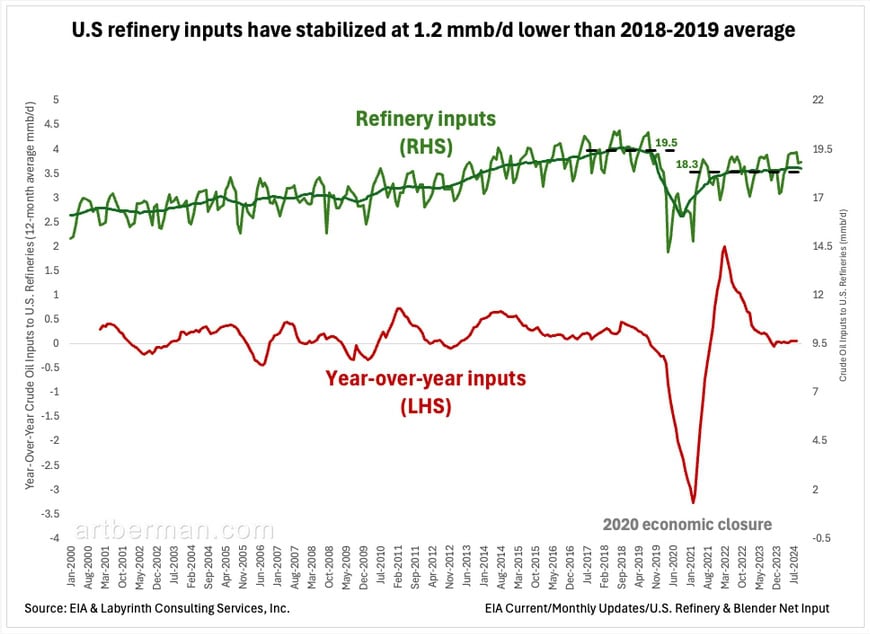
Source: EIA & Labyrinth Consulting Services, Inc.
The real issue is simple: oil prices are too high for the level of demand. Prices are driven by market fears over supply and geopolitical risks, which keep them elevated. That might work for markets, but it’s killing refiners.
A quick way to gauge refinery profitability is by using the “crack spread,” which is the difference between what refineries sell gasoline and distillates for and the price of crude oil. Most refineries follow a 3-2-1 crack spread: from three barrels of oil, they produce about two barrels of gasoline and one barrel of diesel or heating oil.

Source: EIA & Labyrinth Consulting Services, Inc.
The crack spread emphasizes that about two-thirds of a refineries profit comes from gasoline. The significance of that cannot be overstated.
Crude oil goes into a furnace, heats up, and flows into a distillation tower (Figure 3). The lightest products—natural gas liquids and gasoline—rise and separate first. Further down the line, you get the heavier products like kerosene, diesel and fuel oil.

Source: CME
Refineries don’t work like a restaurant where you can order up the diesel and skip the gasoline. They produce a set mix of products whether you want all of them or not. There’s some wiggle room at the edges—refiners can shift a bit of gasoline over to diesel. But the volumes are limited; it’s not a game-changer.
Refiners have survived lower margins before, but if current trends persist, expect cutbacks. Two major U.S. refineries will shut down in 2025, the first cutting 264,000 barrels per day of capacity, with another 139,000 barrels per day set to go offline later in the year (Figure 5).

Source: EIA STEO & Labyrinth Consulting Services, Inc.
Many think electric vehicles will cut gasoline demand, shrink oil production, and solve climate change. It’s not that simple. Oil production won’t disappear just because EVs are gaining ground.
Even if gasoline demand drops, refiners can’t just stop making it. Crude oil refining produces a mix of outputs—gasoline, diesel, jet fuel, kerosene, and heavier oils—all tied together. Cutting back on one product, like gasoline, without affecting the others isn’t practical. Refining doesn’t work that way.
Techno-optimists think refiners can easily adjust to a different mix of inputs or outputs, but they ignore the reality of feasibility, scale, and cost. The recently completed Dangote Refinery in Nigeria, with a 650,000 bpd capacity, cost $20 billion to build. Kuwait’s Al Zour Refinery, at 615,000 bpd, came in at $14.5 billion. These projects highlight the staggering financial commitment required for large-scale refining.
The last major U.S. refinery was Marathon’s Garyville plant, built in 1977. Since then, no one has stepped up to build anything comparable in the U.S.
The world runs on petroleum products, whether people like it or not. Ships, trains, and trucks keep global transport moving, and the raw materials for solar panels, wind turbines, and EVs rely on mining, manufacturing, and distribution powered by refined products. Thinking the world can simply abandon oil is pure fantasy.
A peak in oil production and consumption is coming sooner rather than later. Refinery struggles offer a glimpse of how tough and messy global adjustments will be, along with the economic damage supply disruptions could cause. Instead of clinging to simplistic solutions—whether it’s drill-baby-drill or a total ban on fossil fuels—we’d be better off starting with a clear understanding of how the world actually works.
Like Art's Work?

Share this Post:

Read More Posts
And then of course there’s the plastics produced from petroleum. Take stock of just how much of what we make now has a significant plastics component, automotives sector included. Imagine if suddenly we removed that component. To be substituted with ???
Jon,
I have discussed plastics in many posts but they are not a direct product of the refining process so were not highlighted in “Refining Realities.”
All the best,
Art
“Prices are driven by market fears over supply and geopolitical risks, which keep them elevated.”
I hope you do a post to unpack that statement. Or if you already did, please send me there.
Also, Richard DP asks, “Why is demand falling in the US? Is it due to structural changes? Is the economy going down? Is it going to reverse if we get a boom? Is it demography?” You referenced This is How Oil Ends. I just re-read that post. It does demonstrate that demand is falling. It seems to pin the fall on economic slowdown in China, Europe, and parts of Asia. Are you saying that those are causing demand to fall in the US? I understand that every part of the world is economically connected to every other part, but still don’t understand why economic slowdown in those places would cause demand in the US to fall.
So sorry for asking so many dumb questions. You provoke so much thought for me it gives me insomnia!
Robin,
As I just answered Richard,
The simple answer is that many people can’t afford more than basic necessities so they’re cutting back on all spending. That’s why people voted for Trump.
All the best,
Art
Echoing a previous comment it really is a treat to hear from you twice in one week. I’ve been thinking of your insights recently while reading the poet Alexander Pope’s poem “ Essay On Man”. In this long poem replete with detail Pope brilliantly and incisively places man within the realm of nature and condemns our attempts to rise above it— or, more precisely , believe we can live outside it, A child of the post-Newtonian world, he gives Reason its unique place but warns against upsetting the vast, mysterious, intricate chain of being. Pope was no “bleeding heart” or reactionary and was famous for his biting satires. Like yourself, he did not suffer fools gladly.
Thanks, Joe.
I’m glad that you mentioned Newton in your comments. Iain McGilchrist makes this observation:
“Newtonian mechanics is just a handy approximation that can be overlaid on quantum mechanics for practical purposes provided it is restricted to the day-to-day level. It won’t help us understand the underlying reality. In fact it misleads us there, but it has its own prodigious usefulness.”
I’ll add this from Erwin Schrödinger:
“The world is given to me only once not one existing and one perceived. Subject and object are only one.”
In our obsession to divide the world into parts, we seem to have lost what our Paleolithic ancestors took for granted: life is a mystery that cannot be solved. It may, however, be understood in the union of science and metaphysics, recognizing that we are part of nature.
All the best,
Art
Art:
Obviously, if demand falls, production will fall. My question is: why is demand falling in the US? Is it due to structural changes? Is the economy going down? Is it going to reverse if we get a boom? Is it demography?
Thought-provoking article.
Richard,
I’ve posted about your question:https://www.artberman.com/blog/this-is-how-oil-ends/
“Which brings us back to energy—specifically oil, the cornerstone of productivity in modern society. Modern economic growth has always depended on cheap, abundant fossil fuels. This high energy yield has driven expansion, allowing credit and debt markets to flourish. Cut back on oil, and if we can’t replace it with equally productive energy sources, overall productivity takes a hit, and with it, economic growth.”
All the best,
Art
Art:
You write:
“These projections are based on a “business-as-usual” or “steady-state” scenario. But the world we’re living in doesn’t fit those assumptions. The forecasts don’t fully account for the economic slowdown in China, other parts of Asia, and in Europe, which are already reshaping demand in ways that these models overlook.”
I’m not going to dispute that. My question is: why is China slowing down? Why is the rest of the world slowing down?
Currently, oil prices are relatively low and supply is ample. There do not seem to be any oil-related reasons for demand to contract. There has to be some other reason. Are we in a recession? If so, then we will probably get out of it in a couple of years and oil consumption will resume increasing. That does not sound like a permanent disruption of demand.
Maybe I’m missing something.
Richard,
You have to read other recent posts for the full story especially “This is How Oil Ends”
https://www.artberman.com/blog/this-is-how-oil-ends/
The simple answer is that many people can’t afford more than basic necessities so they’re cutting back on all spending. That’s why people voted for Trump.
All the best,
Art
Great article Art and 2 articles within a couple days is really a treat. Thanks Art.
Thanks, Bill.
I was distracted last week with family events so I made up for it this week!
All the best,
Art
great article
Thanks, Bruce.
All the best,
Art
Art… Consider this hidden limitation… Capitalisim. (As it is currently practiced) 70% consumer driven requireing a constant expansion rate that is dependant on an ever expanding hydrocarbon production rate. At some point the costs for maintaining the rates of well head decline are going to exert enough downward pressure as to stifle expansion. Oil has no value without an economy. If the costs of expansion of hydrocarbon extraction fail to support the economy the economy will contract. You may be able to prop it up for a while with credit and debt but that will eventually run its course.
John,
I really disagree with blaming capitalism when all economic ideologies have the same effect on energy and the ecosystem. Capitalism is just one manifestation of the human superorganism. Blaming is not a productive way to understand things.
All the best,
Art
Art, what happens seven years down the road when the world needs petroleum products but a lot less gasoline?
H BAL,
We don’t know but that’s the lesson. The world is far more complex than we can imagine.
Science cannot solve the mystery of nature. And that is because, in the last analysis, we ourselves are part of nature and therefore part of the mystery that we are trying to solve.
—Max Plank
All the best,
Art