
The False Promise of Enhanced Geothermal

Enhanced Geothermal Systems (EGS) are advertised as a breakthrough: clean, firm power anywhere, unlocked by drilling and fracking technologies borrowed from shale. The story sounds great. The economics are disastrous.
EGS is probably the most expensive form of electricity ever attempted at industrial scale but it has generated huge excitement among investors, and made its promoters rich. As society slowly wakes up to how central energy really is, almost any “energy solution” is going to attract attention and capital, whether or not it’s affordable or can scale because maybe it will in the future. That’s because our civilization worships at the altar of technology and miracles are part of that religion’s belief structure.
In a recent The New Yorker essay, Rivka Galtchen explained that EGS could supply 20% of U.S. electricity by 2050 but that challenges remain. She is, on balance, optimistic that this technology with rising investment, and its 24/7 low-carbon output can fill gaps left by wind and solar.
EGS involves drilling into hard granite, metamorphic or igneous rocks that are deep enough to be around 200°C because of earth’s geothermal gradient. The rock is “hot” but is also “hard,” meaning that it’s not a reservoir capable of flowing fluids, and it’s relatively “dry” meaning that it doesn’t contain much naturally occurring water.
So EGS projects involve drilling deep vertical wells into this tight rock, and then going horizontal for 3,000 to 6,000 feet. High-pressure stimulation—fracking—is used to crack the rock open to create an artificial reservoir. Water is pumped into the rock, left to absorb heat, then cycled back to the surface.
Conventional geothermal, by contrast, taps naturally occurring hot water or steam in permeable reservoirs near faults or volcanically active zones. Even there, relatively few projects have actually delivered what was promised on cost, timing, output, or long-term performance. There are exceptions like in Iceland but they are rare.
EGS proposes to do something far more technically demanding than conventional geothermal, in worse rock, for more money and at larger scale—despite the fact that the “easy” version of geothermal has struggled to meet expectations.
EGS has been around for the last three decades—mostly in PowerPoint presentations filled with promise and light on delivery. Soultz in France, Newberry and Desert Peak in the US, Habanero in Australia, and the U.S. DOE pilot at The Geysers – all are promised to be scalable, low-cost baseload. They were really small add-ons to existing plants, short-lived pilots, or expensive science projects that never made commercial sense. Basel and Pohang brought a different kind of risk: induced earthquakes and political blowback. The pattern is familiar by now: bold claims, small projects, marginal output, and silence once the subsidies and patience ran out.
Against that backdrop, Fervo is the first EGS company claiming not just technical success but a commercially meaningful breakthrough. Their Nevada project is held up as proof that EGS is finally ready for prime time: low cost, repeatable, and scalable. Those claims deserve close examination.
Fervo states that its geothermal is “already cheaper than similar forms of 24/7 firm power.” In a white paper, the company writes:
Enhanced geothermal offers an opportunity to reduce costs relative to other firm power options—it is already cost competitive with nuclear and traditional geothermal power, and current cost trajectories show that enhanced geothermal will be cost competitive with baseload gas before 2030.
That was a huge red flag for me so I did my own analysis. I found that none of it is true—not even close.
I created three scenarios that reflect real-world field conditions: an optimistic case with relatively shallow wells, lower drilling and plant costs, high output, and a 90% capacity factor; a realistic base case with deeper, more expensive wells, moderate output and thermal decline, higher operating costs, and an 80% capacity factor; and a pessimistic case with still deeper, costlier wells, lower flow rates, strong decline, heavy pumping and chemical treatment, and only about 65% capacity factor.
When I ran the numbers, even the most favorable case barely works: it takes two decades to break even on a PV10 basis, while the realistic and pessimistic cases never earn back their upfront investment (Figure 1). It’s simply not competitive.

It’s easy to understand why Fervo doesn’t provide any public information about the economics. In realistic conditions, the true breakeven cost is about 80 cents per kilowatt-hour. That’s roughly ten times the all-in cost of nuclear power. It’s five times more expensive than even hydrogen.
Why is EGS so expensive? The answer is simple: It has all the cost of shale drilling with none of the payback. A single 20-megawatt EGS project — tiny by grid standards — requires three to five very deep wells, each costing $12–25 million. Unlike oil and gas wells, these wells don’t produce a high-value liquid or gas. They just circulate water down into hot rock and back up again, hoping to pick up enough heat to spin a small turbine. Much of the electricity generated is used to run the pumps.
When something fails the economic test this badly, there’s only one conclusion: it’s not the right application of technology. Just because we can do something doesn’t mean that we should. EGS is a waste of capital and its promoters are being dishonest when they say it’s working, and is competitive with other forms of energy. It’s not.
I doubt EGS can overcome its deep economic limitations over the next decade or two. It seems far more likely that proven technologies like wind, solar, or nuclear will improve on their weaknesses than that enhanced geothermal will.
The analysis behind Figure 1 is simple—and it’s exactly the kind of calculation Fervo’s investors, who have collectively put roughly $1 billion into the company, should be doing themselves. My guess is that some of them have but still miss the core idea of net energy: what’s actually left for society after subtracting all the energy spent to find, extract, process, and deliver it.
Others may grasp that point but are betting on a future in which energy is far more expensive, turning even low-probability, high-cost options like EGS into necessary, and potentially profitable options.
On the surface, natural gas seems like the obvious answer to surging U.S. power demand: it’s dispatchable, relatively cheap, familiar to utilities, and can be built faster than nuclear or major transmission projects. But much of the current focus is on directing incremental supply into LNG exports rather than domestic power, and the timelines are longer than they appear. Today’s combined-cycle gas plants face waits of roughly 3–4 years just for the turbines, and closer to 5–6 years from permitting to operation.
When the right answer doesn’t work—or doesn’t seem to work—you’re no longer dealing with a narrow policy error or a missing technology. You’re looking at system complexity.
Ilya Prigogine showed that open systems that are far from equilibrium can self-organize into what he called dissipative structures: islands of order that survive by using large amounts of energy. As they grow more complex, the energy needed to maintain all their internal connections rises. Push them hard enough and they reach a crisis point: either they reorganize into a simpler or different structure that can survive on the available energy flow, or they lose coherence and collapse.
Prigogine was working with physical and chemical systems, but Nate Hagens has pushed those ideas to the level of society, which he argues has a metabolism. Like an organism—or more specifically, a superorganism—its energy use scales with its size. As complexity grows, society needs ever more energy just to hold itself together. Once those energetic demands overshoot what the structure can realistically supply, the outcome is not a smooth adjustment but collapse. That is at the heart of our current predicament.
Technology always comes at a cost. Every technological “solution” rests on higher energy use somewhere in the system. The shale revolution is a textbook case. In the early 2000s, global oil supply was essentially flat while demand—driven especially by China and other developing countries—was surging. New fields were being found, but they took longer and longer to bring onstream because they were offshore, often in deep water, or tied up in difficult political and fiscal regimes where progress was slow. By the time these projects finally came online, older fields had depleted, so there was little or no net increase in supply.
Tight supply pushed oil prices to very high levels, which in turn spurred the innovations we now call the shale revolution. Within about a decade, new shale production flooded the market and prices collapsed in late 2014. This was celebrated as a triumph of technology that had “made oil cheap again” and supposedly killed off the peak oil concerns that were so prominent when supply was tight a decade earlier. But the reality wasn’t that simple.
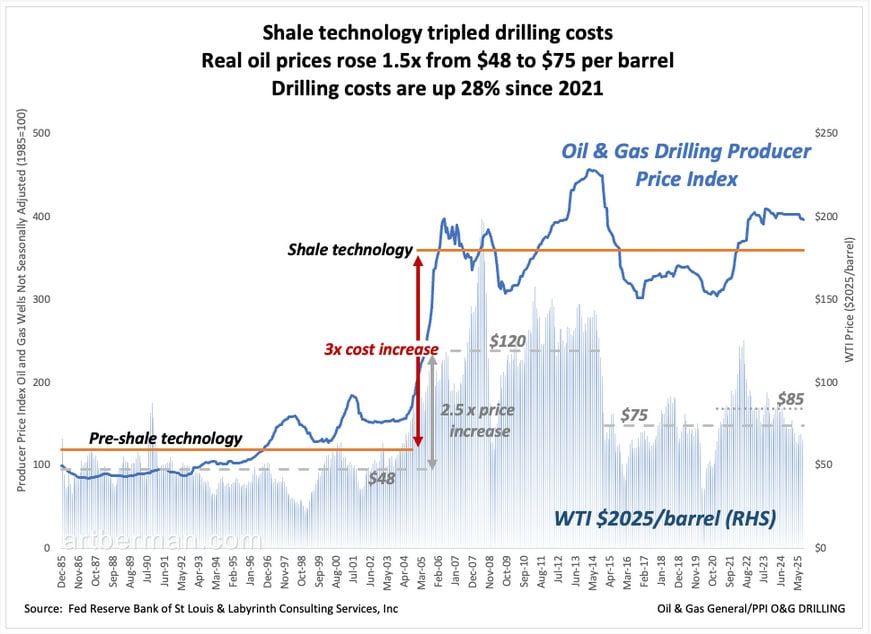
As Figure 2 shows, even after the price collapse, oil never returned to its pre-shale level in real terms. The real WTI price is about 1.5 times higher—$75 versus $48 before shale. Over the same period, drilling costs roughly tripled and have risen 28% just since Covid. The average WTI price since 2021 is $85, and even today’s supposedly “cheap” $59 oil is still about 25% higher than the pre-2006 average.
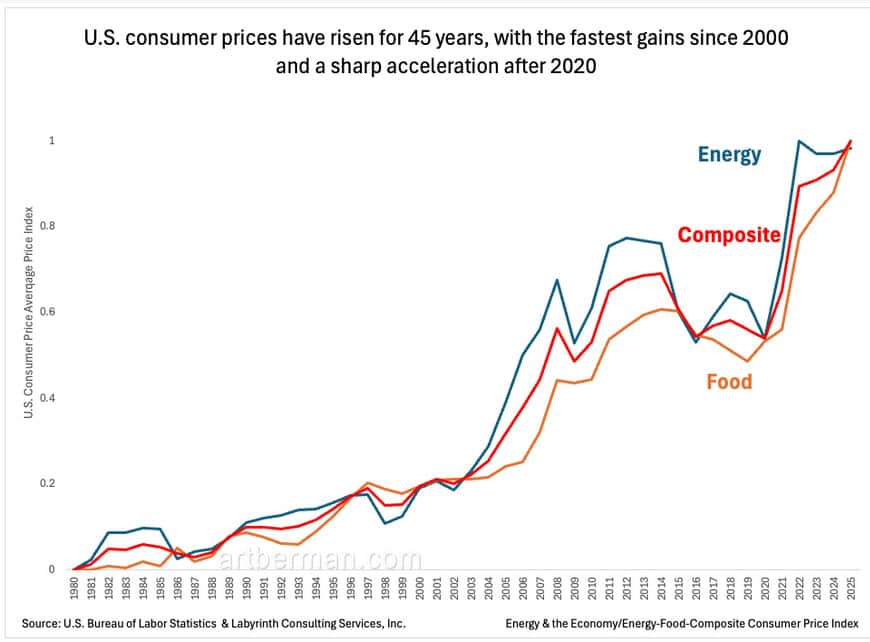
These higher energy costs have made everything more expensive. U.S. consumer prices have risen for 45 years, with the steepest increases since 2000 and a sharp acceleration after 2020 (Figure 3). That goes a long way toward explaining why so many people feel desperate and angry, and why they are drawn to populist movements that promise to fix things. But those movements can’t change the underlying energy reality with different positions on immigration, taxes, tariffs or interest rates. They are offering policy answers to a biophysical problem.
Conventional economics assumes the economy is driven by money, which we can lend into existence and then manage through monetary policy.
Tim Morgan has shown this is backwards. The economy is not fundamentally a financial system but a physical one. It uses energy to turn raw materials into the goods and services we call prosperity. We really need to think in terms of two economies, he writes. First, the real, material economy, where energy and resources are used to make things. Second, the financial, or parallel, economy of money and credit. The financial economy is only a synthetic derivative—a web of claims—of the real one. When these two stay roughly aligned, we have equilibrium: financial claims can actually be met by what the material economy can deliver.
Today they are badly misaligned. We have created an enormous volume of financial claims that cannot be met in real, material terms. That’s why a major downsizing of the financial system is probably unavoidable, and will appear as “value destruction” through deflation.
Enhanced Geothermal Systems is a scam, but its appeal says a lot about who we are. When reality scares us, we reach for “solutions.” We seem either unwilling or unable to see that most of our problems are the direct consequences of growth. Rather than accept limits, we chase stories that let us believe we can keep everything we like and solve the rest with innovation. We’ll try almost anything before we’ll be honest with ourselves.
I’m not pessimistic about the future, but we need to stop pretending it will look like the past. We’re an ingenious and adaptable species. We will endure—and possibly thrive—but not by denying change. I don’t expect us to become collectivley honest about our predicament until events force it. But as individuals, we are not powerless. Those willing to confront their fear, understand limits, and let go of comforting illusions can begin now. We can build the foundations of a different kind of prosperity—one based on being part of the way things are, and finding meaning in community. The challenge ahead is to develop a different relationship with the earth and with energy so we can have a future that reality might actually permit.
Like Art's Work?

Share this Post:

Read More Posts
Art, are you familiar with Eavor? They claim deep rock geothermal with no fracking.
https://eavor.com/
https://eavor.com/eavor-deep/
Geoff,
Eavor is as close to fraud as it gets without crossing that legal line.
It’s physics-defying fantasy for dummies.
All the best,
Art
Bonjour Monsieur Berman.
L entreprise à laquelle je suis salarié Roquette frères producteur de produits issu de l’ amidon de blé et de maïs a investi dans cette technologie avec une centrale géothermique d’ une capacité de 24MW thermique en Alsace.
Le projet a été subventionné et ils sont aussi en recherche( une autre entreprise)pour récupérer les sels de lithium.
C est comme le nucléaire ce sont de projet onéreux et limités en volume etc mais intéressant pour ceux qui en profitent.
Merci pour vos analyses
La géothermie et le nucléaire ont probablement des applications de niche, Romain, mais ils sont hors sujet comme réponses à notre impasse globale.
Bien à toi,
Art
Context for your analysis of Fervo:
“For all their power and vitality, markets are only tools. They make a good servant but a bad master and a worse religion. They can be used to accomplish many important tasks, but they can’t do everything, and it’s a dangerous delusion to begin to believe that they can — especially when they threaten to replace ethics or politics. … That theology treats living things as dead, nature as a nuisance, several billion years’ design experience as casually discardable, and the future as worthless.
**At a 10% percent real discount rate**, nothing is worth much for long, and nobody should have children.”
-Amory Lovins, Natural Capitalism
Brent,
It may surprise you to learn that I know a thing or two about markets after 50 years of systems analysis so don’t lecture me on what-aboutism. Amory Lovins is an idiot savant IMO.
Carefully consider my objective analysis of geothermal and accept its consequences. There are very few things in the world that I am certain about but the laws of thermodynamics will never support anything as incongruous with the Maximum Power Principle as enhanced geothermal energy.
All the best,
Art
It’s not what-aboutism.
It’s a question of whether one is attempting to solve a problem within the context that created the problem in the first place.
As you have noted, there is nothing – no technology or resource – that can sustain the rate of growth that fossil fuels have enabled over the last two centuries.
But that is not the same thing as saying that there are no technologies that can provide a sustainable basis for an industrial civilization. Such solutions exist – you just can’t presuppose an 10%+ annual rate of return as a starting point.
The thing we MUST sacrifice is cannibal capitalism’s demand for growth without end.
Sacrificing high technology industrial civilization (and democracy, civil rights, gender equality, pluralism, and all the rest) is a choice.
I’m not going to argue with you Brent.
You can blame the state of things on whatever you like but that’s just your fear showing.
Art
I’m afraid I’m not optimistic at all Art, I don’t believe that without flammable fossils available as fuel and feedstocks 8+ Billion humans can be supported no matter how frugal their lifestyles, so in that in respect I’m a Doomist. So Doomist am I, I’m hoping to die just before fossil fuels run out and the grid collapses, sparing me, while leaving loved ones to face the consequences: rationing > rolling blackouts > total failure > rapid societal collapse.
Catastrophic collapse of community and civilisation may well happen far faster than you may think, I cite two books:
1. Alice J. Friedemann – “When Trucks Stop Running” (non-fiction): explains why everything depends on diesel transport and electricity.
2. Kurt Dahl – “An American Famine” (2024, part novel/part analysis): month-by-month collapse after a prolonged nationwide blackout.
Dahl’s timeline until starvation dominates:
– Week 1: panic buying, fuel gone, shelves empty in 2–3 days, looting starts
– Week 2: home food exhausted for most, major rioting, urban exodus
– Week 3: almost no food left, FEMA/etc. overwhelmed, acute hunger sets in
– Week 4 (Day 21–30): mass realization “we are going to starve”; starvation deaths begin in earnest shortly after, exploding at 6–9 weeks
Core takeaway repeated in prepper circles: ~3–4 weeks after a total grid-down event, the shift from “shortages” to “imminent mass starvation” hits the general population.
Read at your own risk — it’s grim and haunting 😱🤔
Barry,
Doomism is reductive. Reductive or convergent thinking is the fastest linear path to the one-and-only solution. It completely ignores complexity and process. I know Alice Friedemann very well and she is an uber-reductionist.
Alice talks endlessly about the imminent collapse of oil even though she has no experience in the oil industry, asks me my perspective and then ignores it. There are so many more proximal risks than running out of oil that should be the focus of our attention but what do I know after 5 decades as an energy expert?
Left-brain chauvinism has no cure so I forgive you, but that doesn’t excuse the narrow perspective that accompanies it.
All the best,
Art
This indeed describes the heart of our current predicament!
Nate Hagens argues our past shows humans to be cooperative and basically empathic creatures. Joe Henrich in the “The Secret of Our Success” argues are success as a species has been due to our ability to work together, not compete.
Hagens further suggests that with the growth of the “Superorganism” the people who tend to rise to positions of power are more likely to be antagonistic, selfish, cold, and Machiavellian, and through downward causation these values seep into the general population. But he sees some hope in this. As it can drive a small element within the population to differentiate, coalesce, and lead a transition to a different world view.
After all, the Christians started out as just an unkown cult.
Edward,
Among my favorite Iain McGilchrist quotes is “Little though we are, we don’t know how big that is.”
That said, we’re talking about change on an evolutionary time scale. Fortunately, culture’s effect on human evolution is fairly rapid, and your example of early Christians puts that into the correct perspective of centuries to millennia.
All the best,
Art
I have a different flavor of optimism than most people. Many optimists are confident that technology and economic growth will solve all our problems. I’m optimistic that the humans in future generations will have stronger communities and brilliant new ways to live with a lot less energy and materials. I’m not optimistic that the next few decades will be a picnic. Dealing with the decline of energy/materials/population while simultaneously coping with pollution and climate change requires us to put on our grown-up pants.
Scott,
I reject both optimism and pessimism as different masks of fear. I agree with everything else that you said.
All the best,
Art
Good and clear Art. I’ll pass it on.
” When reality scares us, we reach for “solutions.” … “We’ll try almost anything before we’ll be honest with ourselves”.
USA a keystone species in global energy/material and moral ecology?
Many in crisis now globally, wars and all? Look for allies in truth-telling traditions wherever? There are stirrings outside the technosphere. Not the future advertised on the tin. Softer landings I hope.
Philip,
Thanks for your comments and your playful riffs on my closing themes. I’ve written about the latter in several recent posts but my sense is that we must accept an evolutionary time scale for most of these changes realistically.
All the best,
Art
For those interested in learning more about enhanced geothermal technology check out the government sponsored field research site in Utah known as FORGE https://utahforge.com/
Wayne,
I found little useful on FORGE’s website. The most interesting thing was that they’ve found ways to cut drilling time to 6,000 feet. What about the next several thousand feet?
All the best,
Art
Art – I’m curious why you aren’t pessimistic about the future. If, as you say, deflation is largely unavoidable, the insatiable drive for growth inherent in our (USA) society creates vast problems that typically serve to drive prices up, and technological advancement is not the panacea it appears to be (as it always comes at a cost), where is the optimism coming from? It seems to me that humans, as a species, are virtually incapable of planning for anything other than their own short term self-interest. We might have been able to solve societal issues when we absolutely, really, had to in the past with smaller populations and less globalization, but now? It seems the system we have created is simply too large to react coherently in any single direction, and that spells nothing but trouble to me.
Tim,
Read what I wrote. I explained my views quite clearly.
We’ve adapted to ice ages and warm periods, plagues and wars. Why don’t you think we can adapt to whatever is coming next? History argues against your negative perspective.
I believe that many doomers find a weird a kind of security in fatalism. Think about it.
All the best,
Art
We’ve had growth for so long — at least ~7,000 years, since the advent of grain agriculture — that it is hard to imagine what deflation will look like.
Yet, we see it periodically, for short periods. The last significant one was 2008, when many properties lost a significant portion of their market value, and those who were mortgaged to the hilt were “underwater”, and lost their homes. Yet, many who could keep making their payments just “hung on” until things got better — which they eventually did.
Consider if the slope becomes reversed, where deflation and degrowth is the norm, punctuated by brief periods of growth.
Financial capitalism itself will struggle in such a scenario. Financial capitalism is predicated on growth. You “invest” with the promise — or at least a pretty good bet — that your investment will be worth more in the future. But that won’t be true in a future where resource-driven degrowth is the norm, rather than the exception.
Because we’re entering unknown terrain, I am pessimistic, unlike Art. We, as a civilization, a society, and as individuals, simply don’t know how to cope with chronic degrowth.