
The Sunset of the Renewable Dream

The energy transition is collapsing—not in headlines, but in economics. What began as a hopeful vision for a cleaner future has become an economic bust. While markets and workers sense the failure, activists and policymakers remain caught in a consensus trance.
Bill Gates saw the winds shifting and changed course almost overnight. After years of climate evangelism, he now downplays the urgency. The public is angry about inflation, energy bills, and economic stagnation. They no longer see climate change or renewables as relevant to their daily lives. Gates didn’t reposition because the science changed—the political wind did.
Even longtime progressives are pulling away. The CEO of the Progressive Policy Institute now admits the Green New Deal “crashed to earth,” alienating workers by attacking fossil fuels instead of offering real energy solutions.
The failure is global. COP30 exposed the widening gap between climate rhetoric and political will. Six EU countries now want to abandon the 2035 engine ban to save their auto industries. Meanwhile, utilities like EDP Renewables and Orsted are retreating from Southeast Asia as red tape, erratic policy, and weak economics derail the clean energy boom.
The underlying problem is simple: the economics of wind and solar unravel once you ask them to behave like real power plants.
This may come as a surprise, since we’ve been told for years—by governments, banks, think tanks, and the industry itself—that wind and solar are the cheapest energy sources ever built. But that was always a narrow view, based on project-level metrics like Lazard’s Levelized Cost of Energy (LCOE). LCOE asks: “What does it cost to generate one megawatt-hour at the project site?” It ignores the cost of turning intermittent, weather-dependent output into reliable 24/7 power.
Lazard’s reports helped fuel the narrative. They show solar and wind falling from the most expensive to the least expensive electricity sources (Figure 1). Natural gas remains competitive but looks pricier. Coal and nuclear appear cost-prohibitive.

Source: Lazard & Labyrinth Consulting Services, Inc.
But LCOE doesn’t ask the right question. It doesn’t include the cost of backup, storage, grid integration, or the challenge of matching supply and demand second-by-second. It’s not wrong—it’s just not the real world.
Lazard also evaluates relatively small projects—150 MW for solar, 300 MW for wind—compared to the 500–1600 MW size range of typical gas, coal, or nuclear plants.
The entire premise of the transition has been built on an accounting illusion. Wind and solar may be cheap at the generator fence, but not at the system level. The gap between those two is where the economic case collapses.
So I asked a different question: “What does it cost to add 1 GW of wind or solar that actually functions like a responsible, dispatchable generator—backed up, firm, and grid-integrated—at a 10% cost of capital?”
The answer is clear. Once wind and solar are required to carry full system responsibilities in a MISO-type region, the economics fall apart. At a flat power price of 5¢/kWh, neither solar nor wind ever breaks even—not even in the optimistic case. Wind performs better, but both remain deeply uneconomic (Figure 2). The dip around year 15 reflects the cost of replacing first-generation batteries.

Source: Labyrinth Consulting Services, Inc.
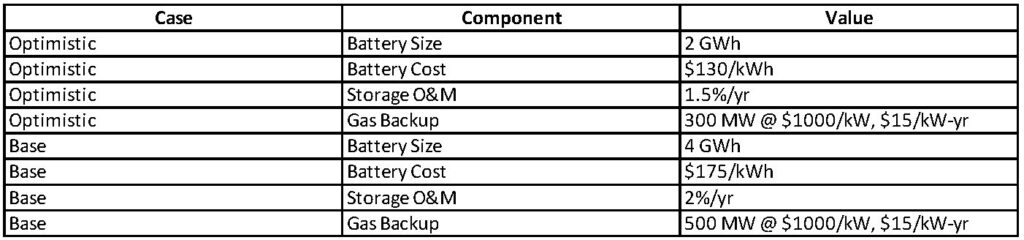
Table 1 outlines the assumptions. These are not extreme. Battery prices are low. Backup is cheap. Integration costs are modest. I haven’t even shown the pessimistic case.
Source: Labyrinth Consulting Services, Inc.
Could technological improvements change this? Possibly—but only at the margins. Lower prices for batteries, turbines, and panels help, but they don’t fix the structural flaws. The core issue is that intermittent sources don’t provide firm capacity. They depend on layers of backup that come with their own capex and integration costs.
That’s why the dream of a 100% electric, mostly renewable economy is not just unlikely—it’s unworkable under current conditions. Renewables may still help displace coal over time. But even that is inconsistent with today’s consumption levels, storage limits, and the world’s vast, cheap coal supply.
It’s telling that the nuclear and geothermal projects I’ve modeled—despite high upfront costs—eventually break even. Wind and solar don’t, because they never produce firm output. Their intermittency prevents them from recovering the negative present value from capex.
Grid engineers have warned about this for years. In the early days, wind and solar were a rounding error—just a few percent of generation in grids dominated by gas, coal, hydro, and nuclear. They were classic “free riders”: their variability was absorbed by the rest of the system, and markets didn’t price their intermittency.
But as their share grew, so did the need for flexible thermal backup, grid-responsive controls, better forecasting, and new transmission. These real costs don’t show up in LCOE. Worse, wind and solar often generate power at the same time, crashing prices and cannibalizing their own market value. As curtailments rise, thermal plants must cover the gaps, pushing total system costs even higher. Spain’s April 2025 blackout revealed just how fragile this arrangement becomes without deep reform.
Scaling is a recurring theme in complexity science and systems engineering. Whether it’s software, infrastructure, or power systems—what works at 5% penetration often fails at 30%. It’s hard to believe engineers didn’t warn of this.
Cheaper parts don’t fix intermittency. They don’t erase the need for backup. They don’t eliminate the costs of integrating into the grid. They just slow the bleeding.
This isn’t an argument against technology. It’s a recognition of physical, economic, and thermodynamic boundaries. You can’t force inverter-based renewables into a system built for synchronous, frequency-stabilizing machines and expect stability to be free. Frequency control isn’t a minor detail—it’s fundamental. The more inverter-fed generation we add, the harder and costlier that control becomes.
Try searching for full-cycle discounted cash flow models for wind and solar like the one shown in Figure 2. What you’ll mostly find are LCOE charts. A recent review of 2011–2020 renewable energy finance literature shows why: the vast majority of studies focus on project-level economics. Almost none incorporate full system costs. This is astonishing, given that over $3 trillion has been invested in renewable energy globally as of 2024.
At this point, renewables resemble a trip to Abilene. The Abilene Paradox describes a group that makes a bad collective decision even though no one individually wants to. A bored family drives to Abilene for lunch. The food is bad, the trip is long, and only afterward does everyone admit they never wanted to go in the first place.
Society went to Abilene on renewables. We didn’t go for lunch. The climate crisis was real. Someone said, “Let’s go with wind and solar.” We went there to redesign the global energy system. Everyone nodded. No one checked the map.
This isn’t a failure of technology—it’s a failure of imagination. We believed we could transition to a fully electric, renewable economy without confronting growth, consumption, or planetary limits. The carbon pulse gave us a century of abundance. The challenge now isn’t to recreate it with wind and sun. It’s to grow up as a species—and learn how to live within the boundaries of a planet that no longer tolerates business as usual.
Like Art's Work?

Share this Post:

Read More Posts
Isn’t the 5c/kWh very low? I understand that all of the other problems don’t go away at 20c/kWh, but I’d be interested to know what the model shows then.
Greg,
5¢/kWh is a realistic wholesale clearing price in competitive power markets. Grid operators don’t really care about the producers true cost.
Why would you run an economic model at unrealistic wholesale prices? If you did it for renewables, you’d have to do the same for natural gas and the relative difference would be the same–renewables aren’t competitive.
All the best,
Art
Hey Art,
This post fits pretty well with Jean-Baptist Fressoz’s latest book (that’s translated into English) “More and More and More” – would love your thoughts on the book.
Cheers,
Luke
Luke,
I haven’t read Fressoz’s book, but I watched his discussion on Nate Hagens’s podcast. As a historian rather than a scientist or energy economist, he brings a critical, historical perspective to the energy transition and the renewables debate — one I value and largely agree with.
We share a deep skepticism toward the idea of a rapid, renewable-led transition. Where we differ is in focus: Fressoz examines the historical narratives and societal perceptions around energy, while I’m more concerned with present-day energy economics, political constraints, and the broader planetary, ecological, and evolutionary implications of a failed energy transition.
All the best,
Art
First, “At a flat power price of 5¢/kWh, neither solar nor wind ever breaks even”. Even back in the 1990’s when I was working on developing, financing and building Co-generation power plants, a gas fire 50 MW plant would just break even at that price.. this of course is linked to the cost of natural gas…. But I agree with your point, renewables are dogs in the current economic and societal reality.
Second, the engineers did warn that renewables had a “shit ton of issues”, simply put for renewables to work it is ALL about “load management” and the ability to dispatch load when power cannot be generated. Given our existing society expectations and economics this is a “non starter”. It requires our economy and society to rethink how electricity is used and to start with a clean sheet of paper. Not going to happen, IMO the current system will have to crash and be rebuilt, and the resources will more than likely not be available in such a scenario.
And then you have the whole EROEI issue to consider… and the solar pv numbers are not so good. The storage consideration, going from dc to ac (inverter) kills it, even in a small home system.
We (boots on the ground engineers) were screaming this at the top of our lungs!!!
I have lived off grid with a small base load solar for about 10 years. It is ALL about load management, more so at night. (Example, do I binge on a Netflix show or take a nice long soaking tub and run the well pump? Or do I do both and have the system shut off due to low battery voltage at 3am and have to wait till the sun rises to get power back). And then the icing on the cake is the reliability of PV systems, simply put it is a PIA to maintain long term.
L Racine,
Thanks for those comments. The big difference between natural gas CC and wind and solar it that gas does break even and eventually makes money because it is capable of firm generation at a high capacity factor. Even nuclear and geothermal break even eventually for the same reason.
Wind and solar never break even because they never reach firm production. End of story.
EROI is an elegant concept and Charlie Hall is a dear friend of mine but it’s not a particularly useful approach except perhaps at the highest macro level of a all global energy systems.
Keep screaming–though only a few of us will be listening.
All the best,
Art
Hi Art,
Your article is, as usual spot on. There are a couple things that that make matters even worse.
Currently we’re building out solar and wind using The Magic Wand (fossil energy), the secret sauce that can make so many things at scale and low cost. Such as sort of kind of get into outer space sometimes for a while.
If we were building or even rebuilding solar and wind with solar and wind then it would be even more expensive and less feasible.
Do you know of anyone that has done long term modelling on this?
Also wind and solar loose %5 of their capacity every year, since the life span is about 20 years. If you assume a magical complete build out of solar/wind then the number of turbines and panels that need constant replacement is staggering.
Not to mention the elephant in the room, what it is we do with energy, as if that is benign.
All the best
Derek
Derek,
Simon Michaud has done exhaustive research on the material requirements of replacing fossil fuels with electricity:
https://www.gtk.fi/en/research/time-to-wake-up/
All the best,
Art
I don’t recall Simon’s reports getting into the specifics of whether a theoretical fully built wind/solar industrial civilization could be self sustaining.
Might be time for another deeper look, probably even some new reports now.
Cheers
Derek,
Simon did not. I’ve never seen a publicly available model like the one I posted.
All the best,
Art
Thank you for calling out Lazard and their LCOE. I find it fascinating that so many people bought into Lazard’s LCOE when all that was needed was to read the litany of factors they list on the bottom of page 7 that they don’t bother including in their analysis. This “caveat” has been in previous versions as well. https://www.lazard.com/media/5tlbhyla/lazards-lcoeplus-june-2025-_vf.pdf#page=7 . At least the Clean Air Task Force has done some push back with their publication in June, 2025. “Policymakers and industry need to move beyond LCOE to build reliable, affordable, and clean energy systems, finds new CATF report” https://www.catf.us/2025/06/policymakers-industry-need-move-beyond-lcoe/ The United Nations Economic Commission of Europe is also pushing back with their report released Sept. 2025 “Understanding the Full System Cost of the Electricity System” https://unece.org/sed/documents/2025/09/geces-212025inf2-understanding-full-system-cost-electricity-system
Todd,
Thanks for your comments and the links.
LCOE is a bogus way of looking at electricity costs but it has been a remarkably effective marketing tool. The Bullshit Asymmetry Principle suggests we’ll never turn around the misperception that wind and solar are the cheapest form of energy.
All the best,
Art
We haven’t always assumed we could just replace the existing system, like for like. Back in the eighties I remember the main slogan was Reduce-Reuse-Recycle, there were posers of it everywhere; back when we were being more honest. But the narrative didn’t suit vested interests or our economic system, so the first two got quietly dropped and the third got perverted into a lie.
Thanks, Drew.
The “earth” movement of the 1970s was co-opted by the renewable energy industry. I have seen nothing showing the economic absurdity of that before this post.
All the best,
Art
I think it was more human nature not vested interests that prevented Reduce-Reuse-Recycle from making a deeper change. Like all animals, we want to Grow-Dispose-Move on.
“It’s to grow up as a species—and learn how to live within the boundaries of a planet that no longer tolerates business as usual.”
The problem is that those boundaries include finite resources (not that they’ll physically run out for centuries or millennia but they’ll become too difficult to extract) which makes modernity impossible to support. And this is aside from the damage done to the biosphere by our life-styles. No-one wants to go back to hunting and gathering but that is really the only lifestyle which could be sustainable. If we don’t want to live sustainably, then we’ll have to just deal with collapse when it comes.
Thanks for your comments, Mike.
All the best,
Art
Hey Art,
Great context on the renewables issue – do you agree w/ Vaclav Smil’s assessment that there simply isn’t enough accessible copper to electrify as well?
Thanks,
Luke
Luke,
Electricity is not a replacement for 80% of what makes our civilization run. Smil can sweat the details of copper, etc.
All the best,
Art
If your desire is to reduce consumption then expensive renewables represent a feature rather than a bug. Unfortunately, as you have eloquently pointed out, not many people wish to reduce their consumption.
Steve,
My desire is for people to have an honest conversation without trying to solve anything just to let the magnitude and gravity of our situation dawn on them.
All the best,
Art
One of your best ever Art, thanks.
The simple reality people forget with all the LCOE ‘non real world’ nonsense is that all industrial processes using continuous high grade electricity are only as efficient as they are, by using consistent, continuous electricity.
Take an Aluminium smelter as a perfect example, in Indonesia they are building Aluminium smelters with captive coal fired power plants, as it’s the actual cheapest form of continuous high grade electricity. No-one anywhere is build an Aluminium smelter on a captive solar, wind and battery backup, because it’s way too expensive to do, and takes up vastly more land as well.
You’ve nailed the point about the LCOE being the wrong measurement for the real world extremely well. Yet how often do we still hear in the media that solar, wind and batteries are the cheapest form of electricity, from the uninformed. It’s the denial of reality that’s a huge part of our predicament, and it’s not likely to change easily..
Hideaway,
Thanks for your comments. I imagine that most people assume that industrial processes like smelting don’t use wind and solar because of intermittency. Electric arc furnaces are an alternative to coal but it’s a more expensive method and what happens if the power goes out?
My sense is that few think about the complexity or our energy and industrial systems, and just focus on a part or maybe a few parts. They may not be capable of thinking about complex, interdependent processes–not because they’re unintelligent but because of their left-hemisphere dominant thinking style.
All the best,
Art
“Take an Aluminium smelter as a perfect example…”
Meanwhile, dein Führer has tariff’d cheap Canadian aluminum made with cheap and plentiful hydropower.
Boggles the mind.
The food is surprisingly good in Abilene. If you are interested in hearing about our city’s decision making and the economic risk renewables presents at a local level feel free to reach out. Im also in the exploration side of the oil business. I have followed your publications for a decade now and I appreciate your opinions. Good luck out there.
In Figure 2, why are there not dips at years 30 and 45?
Greg,
There are assumption in the model about improvements in technology over time.
All the best,
Art
I agree, but –
Do you remember the slogan ‘the wind is always blowing somewhere’? I’ve seen papers on renewables showing that wind can provide base power, provided the stations are far enough apart. This was a civil engineering failure. This is why they believed that they did not need storage or backup power. The studies were done incorrectly, but threats of lawsuits from environmental organizations prevented people from speaking out.
Richard,
People need to be believe in solutions. Renewable energy companies believe in free money to support their Ponzi scheme. It’s really that simple.
All the best,
Art
I just listened to Paul Krugman extolling the miraculous virtues of wind and solar. To me it was further confirmation that economists, among many other high IQ academics, have trouble incorporating enough necessary information to speak wisely about energy.
Scott,
The LCOE dogma is strong. I doubt Krugman could have a 3 minute conversation with me about renewable economics because he’s never done the work.
All the best,
Art
Arthur,
Thank you for this very interesting article.
What are your thoughts on including production asset such as CSP (for example in Spain or Portugal) which can operate at night thanks to the heat produced by the sun during the day and are therefore less intermittent ?
Kind regards
Philippe
Philippe,
CSP is another science fiction fantasy. It reflects our infantile refusal to be honest about the reality of our predicament as a species with nature and the laws of physics.
All the best,
Art
LCOE reminds me of the early promises made by CEOs at independent oil and gas companies when unconventionals started kicking off. Incredible project economics were trotted out to the public without incorporating the cost of the land acquisition and a host of other expenses that would have blown through the smoke and mirrors.
Tim,
The early shale gas story and LCOE are similar. The difference is that there was real value in the shale plays. They were economic at some point while renewables don’t seem to be.
Shale plays produced high energy density oil and gas; renewables produce electricity from low power density sun and wind. Huge difference.
All the best,
Art
Arthur,
I’ve found your work both enlightening and validating—concrete evidence and explanations that confirm my gut instincts on the steep challenges humanity faces. “Energy junkies” is an apt descriptor for us, and, like all junkies, addressing our addiction is the driver behind every decision we make.
My question is: How do we even begin a conversation about rehab? I’ve always viewed the renewable energy strategy as at best a bridge and at worst a dangerous folly (the latter is what you articulate so well). I held on to optimism that once we crossed the green energy bridge, we would figure out ways to live with less. I naively thought this was the stance of many green energy proponents, but now I see that I was wrong. Do you have any thoughts on a message that could shift this thinking? Are we too deep into the addiction to change course outside of the hard reset waiting for us at rock bottom?
Johnny,
I don’t think addiction to energy is our problem. It’s the way we think.
I recommend reading my essay “Only Our Children Will Cross the River” https://www.artberman.com/blog/only-our-children-will-cross-the-river/
Iain McGilchrist offers a powerful answer in The Matter With Things:
“I believe we have systematically misunderstood the nature of reality…The problem is that the very brain mechanisms which succeed in simplifying the world so as to subject it to our control militate against a true understanding of it.”
His hemisphere hypothesis is, in my view, the best science-based framework for understanding human behavior. The brain has two complementary ways of looking at the world. The left hemisphere is narrow, literal, analytical and focused on control and explicit rules. The right sees the whole in context. It’s intuitive, relational, comfortable with ambiguity and nuance, and attuned to meaning.
All the best,
Art
“It’s to grow up as a species—and learn how to live within the boundaries of a planet that no longer tolerates business as usual.” Which means? About 80% less energy consumption overall? Much simpler lives? Local energy production rather than integration into the grid?
Andrew,
I offer consulting if you need more information than I offer for free on my website.
https://www.artberman.com/contact/
All the best,
Art
80 percent less energy, 80 percent less food (if we’re lucky), and at least 80 percent less humans, which ironically would put us at the carrying capacity of the planet, or what it was decades ago before we did all this damage. Physics will almost certainly reduce the human population by 90 percent or more, if not make us altogether extinct within the next century.