
The Iran War: A World-Changing Event

On February 28, oil tankers stopped moving through the Strait of Hormuz.
Roughly 20 million barrels of oil per day—about one-fifth of global supply—suddenly stopped flowing. Oil is the lifeblood of the global economy. The system just had a heart attack.
This was not an obscure risk buried in energy-market reports. The vulnerability of the Strait of Hormuz has been front-of-mind for energy analysts for decades. And yet, here we are.
The Iran War could become the most consequential geopolitical blunder by an American president in modern history.
Carlyle’s Jeff Currie summarized the situation bluntly.
“You’ve disrupted supply chains in countries all over the world. Ships are in the wrong places, the insurance is being canceled. You’ve taken the pressure out of the fields that you shut-in in places like Saudi Arabia or Iraq or even in the UAE. This goes on and on. The damage is going to take months to unwind. There is no policy response that can stop this descent. None”
The problem is not just lost oil supply. Modern civilization depends on uninterrupted energy flows through a handful of fragile chokepoints.
If there is a plan to get tankers moving again, it is not evident. The U.S. Navy has offered escorts through the Strait, but not a single ship has taken the offer. If there is a coherent war strategy, it has not been communicated. The objectives appear to shift depending on whether President Trump, Defense Secretary Hegseth, or Secretary of State Rubio is explaining them—and they seem to change from day to day.
After a classified briefing on March 10, U.S. Senator Chris Murphy described the first ten days of the war as “a disaster of epic proportions, a 10-day debacle.” That is a reasonable assessment—even if one discounts it because Murphy is a Democrat.
Oil prices surged to nearly $120 per barrel when markets opened on Monday, March 9, before falling into the upper $80s after Trump said the war would end “very soon.” Brent has since moved back toward $100 as markets absorb the new reality. The oil market is not clearing because available physical barrels are trading at premiums of as much as $40 per barrel—levels refiners simply cannot absorb.
OECD countries have agreed to release 400 million barrels from strategic reserves, but that will take roughly six months to reach markets because withdrawal capacity is limited to about 2 million barrels per day.
Markets can be calmed with rhetoric. Eventually they respond to data. And the data is clear. The crisis is less than two weeks old, and oil-price volatility already exceeds that of the oil shocks of the 1970s and 1980s (Figure 1).
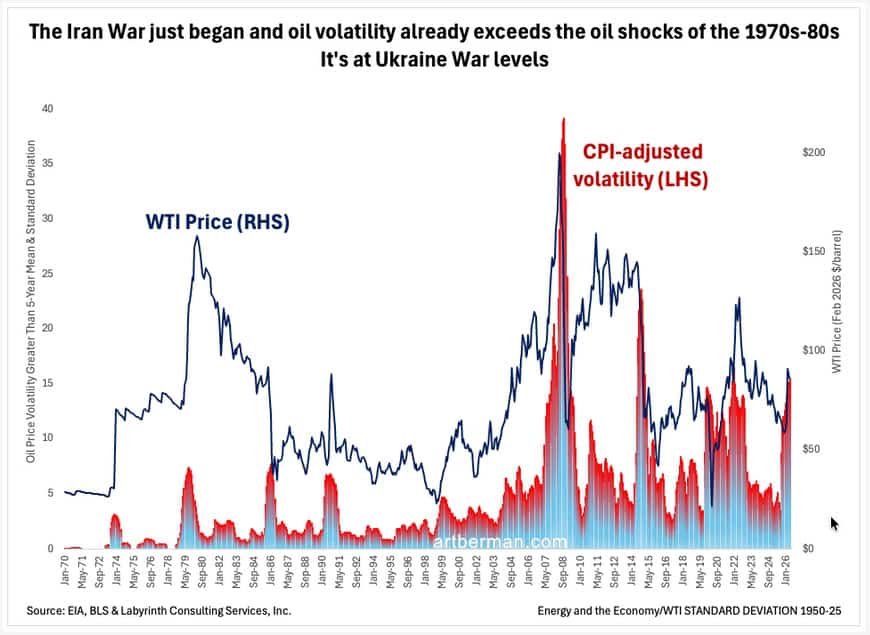
Source: EIA, BLS & Labyrinth Consulting Services, Inc.
Even if the military campaign succeeds, the damage is already done. The war has exposed the structural vulnerabilities of the global economy—especially how thin global energy supplies really are and how dependent the system is on a handful of critical chokepoints.
Nate Hagens describes these forces as the four horsemen of the coming decade: finance, geopolitics, fragile supply chains, and the erosion of governance (Figure 2). Together with climate disruption, these interacting forces threaten to destabilize the economic superorganism as it approaches its biophysical limits.

Source: Institute for the Study of Energy and Our Future and Labyrinth Consulting Services, Inc.
The closure of the Strait of Hormuz has halted the flow of roughly 20% of global oil and natural gas—an unprecedented disruption. The largest previous supply shock occurred during the Iranian Revolution of 1978–79, when about 5 million barrels per day were lost over roughly six months. As Table 1 shows, when normalized for time and scaled to the size of the global market, today’s disruption represents a rate of supply loss nearly 100 times faster than the shocks of the late 1970s.

Source: Labyrinth Consulting Services, Inc.
The situation for natural gas is similar. The Persian Gulf accounts for roughly 20% of global LNG trade, largely from Qatar—about 80 million tons per year, or roughly 11 bcf per day—almost all of which passes through the Strait of Hormuz. Most of this supply goes to Europe and Asia. Unlike oil, LNG cannot easily be rerouted through pipelines, and global storage capacity is limited. The effects are immediate. Traders are already diverting cargoes at sea to the highest bidders.
Resolving the Hormuz chokepoint is not simply a military problem. Tankers cannot operate without insurance, and coverage has already been withdrawn. Nor will shipowners risk the lives of their crews even if insurance were restored. Most estimates suggest that even if the crisis ended immediately, tanker traffic would take roughly two months to normalize.
The longer-term effects will persist well beyond that. Rebuilding inventories and stabilizing markets will take time, but the deeper damage is confidence. If buyers conclude that Persian Gulf energy supply can no longer be relied upon, global trade flows will shift. Diversification away from the region will accelerate. Strategic stockpiles will expand. Electrification and efficiency will gain urgency. Geopolitical alignments tied to energy markets may change.
The system is unlikely to return to the way it was.
Fertilizer, food, and water systems are also exposed. Fertilizer production depends heavily on natural gas through the Haber–Bosch process, and the Gulf region is both a major LNG supplier and a major exporter of finished fertilizer. Roughly half of global food production depends on synthetic nitrogen fertilizer. When fertilizer prices rise, farmers apply less and yields fall.
Energy costs make the problem worse. Diesel powers farm machinery, irrigation pumps, trucks, ships, and the equipment that moves the world’s raw materials. The crude moving through the Persian Gulf is particularly well suited for producing diesel and jet fuel. When those supplies disappear and refineries shut down, the diesel market tightens quickly.
Water adds another vulnerability. Countries across the Persian Gulf rely heavily on energy-intensive desalination plants for drinking water. Damage to those systems—or to the energy infrastructure that powers them—could create immediate humanitarian crises.
The Iran War does not simply threaten oil and gas supply. It threatens the entire system that depends on cheap, reliable energy—the entire global economy.
Some actors will benefit from the disruption. Energy producers outside the Gulf—Russia, U.S. LNG exporters, Atlantic Basin oil producers, North American fertilizer manufacturers, and U.S. petrochemical companies—gain from higher prices and more secure supply chains. The losers are energy-intensive sectors and energy-importing economies: airlines, European and Japanese heavy industry, and automakers heavily exposed to large vehicles.
Even after marine traffic resumes, feedback effects will pass through the global economy for months or years. Supply chains must realign, inventories must rebuild, but confidence may never be fully restored.
Many consequences are already in motion. Some may prove irreversible; others remain unknowable. Forces that have been building for decades—visible during the financial crisis, Covid, and the Ukraine war—are now converging.
Economists have long minimized the importance of energy because it accounts for only about 3 percent of global GDP. How important could 3 percent be?
But modern civilization runs on energy. Energy grows food, mines minerals, manufactures goods, and moves everything across the planet. When energy flows stop, the physical economy stops. Without energy, most GDP disappears.
There may, however, be one unexpected benefit. This crisis may finally force recognition of how vulnerable our civilization really is—not just to energy disruption but to the fragility of supply chains, agriculture, and geopolitics.
Humans rarely change behavior except under extreme stress. The scale of the crisis could even push adversaries such as the United States and China to focus on what truly matters. Managing this gray-swan catastrophe is in the interest of both powers. Disputes over ideology, currency, and trade may temporarily give way to the shared priority of preserving economic stability and national strength.
What seems clear is that the Iran War is a world-changing event. Conditions may eventually stabilize and begin to feel normal again. But the illusion that the global economy is stable has already been shattered.
Like Art's Work?

Share this Post:

Read More Posts
Aloha Art, Nowhere will a fossil fuel energy shortage be seriously felt than by isolated places like Hawaii and the other Pacific Ocean island groups. Hawaii is almost 100% dependent upon imported fossil fuels and 85% dependent on imported food. Honolulu is like a CAFO 2500 miles away from its support sources. No diesel means no trucks, no JP4 means fewer flights. In Hawaii’s case fewer flights means fewer tourists and a choked tourism economy. Yes, we have wind turbines and solar panels, but they do not produce diesel or JP4. Get ready for a serious lesson in frugality and maybe even the “R” word (rationing). Aloha and regards.
Harold,
Many thanks for your perspective on Hawaii. The economic effects of the Iran War will be unevenly distributed as they were during previous oil price shocks. In the past, developing economies suffered the most.
All the best,
Art
There’s some good in this, the US will wake up to alternative energies, we’ll use less fossil fuel products, we might even start a national energy conservation program, gasoline will get a more actual price – rather than subsidized. A lot of people won’t be able to afford to commute at $10/gal, so they’ll car pool, use mass transit, move closer to their work, walk, bike, etc. Those 40 mile one-way commutes will be a thing of the past. Those monster “connestoga” SUV’s will be traded out for EV’s. All good things that hugely benefit our country, our GDP, health, and overall happiness.
David,
I think you’re indulging in wishful thinking. Renewable energy was always just an add-on that could never replace fossil fuels without a completely different civilizational model. If anything, the latest episode will push climate change to the back of the bus as energy security becomes the only thing that matters.
All the best,
Art
Art,
Well said. A concise, accurate summary of our current predicament (not a solvable problem!) that should be required reading for everyone in the world. Thanks for your continued insights into the energy business and geopolitics.
Mark
Mark,
I appreciate your comments.
All the best,
Art
The reverberations of the 1978-79 Iranian Revolution included massive investments in efficiency as well as down-sizing that reduced U.S. petroleum consumption from it’s 1979 peak for over two decades. If this disruption and price effects are worse, we should expect massive investments in new technologies that will hasten the peak oil consumption date to sometime this decade.
Les,
The argument is sensible but falls apart because the world doesn’t have the fiscal capacity to invest as it did in 1979.
All the best,
Art
You said “ Roughly half of global food production depends on synthetic nitrogen fertilizer. When fertilizer prices rise, farmers apply less and yields fall.” this is not exactly correct. Or rather it’s a bit more complicated than that.
Put simply, N fertiliser is only necessary to the degree that the growing system makes it so. Growing plants doesn’t require inputs. You’re correct however that in large scale industrial agriculture operations they have designed systems that are so far divorced from ecological reality that to grow plants they do indeed require a slew of chemical inputs.
For some of us, forcing growers to look at alternatives is a good thing because much of the harm from agriculture to human health and environment comes from those systems. There are better alternatives (this is a whole separate discussion itself) but culture is slow to change.
The FAO points out that only about 20% of the world’s food is produced in these large scale industrial operations however, with half of that going to biofuels and feedlots. A portion of the other 80% will also be using some degree of inputs (though it varied wildly) so there is still an impact, but those of us out there doing this work have experienced significant reductions in N inputs can have little to no reduction in yield under good management depending on the system. This is already a promising start in moving agriculture towards a sustainable path as let’s be frank, any food system that cannot operate within ecological limits (and is critically dependent on fossil fuels) is doomed to collapse one day and take civilisation with it.
So this transition to sustainable ecological practices is a “need to have” not a “nice to have”. No matter what else is happening.
Otherwise excellent analysis (as usual).
Shane,
You’re technically right, but that’s not the system the world actually runs on today. Industrial agriculture was built around synthetic nitrogen, so when fertilizer shocks hit, the real-world food system feels it immediately—even if better models exist.
All the best,
Art
Urine can replace nitrogen fertilizer. I am writing to my local governor to put the idea forward for door to door urine collection to distribute to local farmers who may bee affected by the shortages.
Gavin,
I eagerly await news on your urine initiative’s progress.
All the best,
Art
The tail does not wag the dog, BUT, energy wags the economy.
The reality is that there is NO economy without energy input.
Dennis,
I said that in the post.
“But modern civilization runs on energy. Energy grows food, mines minerals, manufactures goods, and moves everything across the planet. When energy flows stop, the physical economy stops. Without energy, most GDP disappears.”
All the best,
Art
Safest place in the eWorld to invest, South América. Argentina has everything ready to increase mining, oil &gas, building infraestructura, people, cultura an a promarket governent. No war, no guerrilla, and a changing políticas cultura if people.
Daniel,
Most companies would not invest in Argentina because of its long history of fiscal risk.
All the best,
Art
Here we go. Clearly, we are witnessing a catastrophic miscalculation. Washington assumed that the system was stable, that Iran would back down, and that the disruption would be local. Wrong on all counts. True complex-systems behave differently—they have hidden feedback loops, tight coupling of infrastructure, and, of course, choke points. Some recent colossal blunders of this scale included the July Crisis of 1914 (the Great Powers sleepwalked into World War I); the attack on Pearl Harbor (where Japan misjudged U.S. response); and Operation Barbarossa (Hitler’s invasion of Russia due to overconfidence concerning Nazi Germay’s system resilience.) This one may be worse than all those. Not only will this war mess with the energy metabolism of modern civilization, it will generate a crisis of confidence from which we may never recover. The Great Simplification just shifted into high gear.
Frank,
Sadly, I agree with all of your comments. The conclusion of the Trojan war comes to mind but on a civilizational level.
All the best,
Art
Gladly, I agree with all your comments. The end of industrial civilization is long overdue.